Loading...
1920
Српски
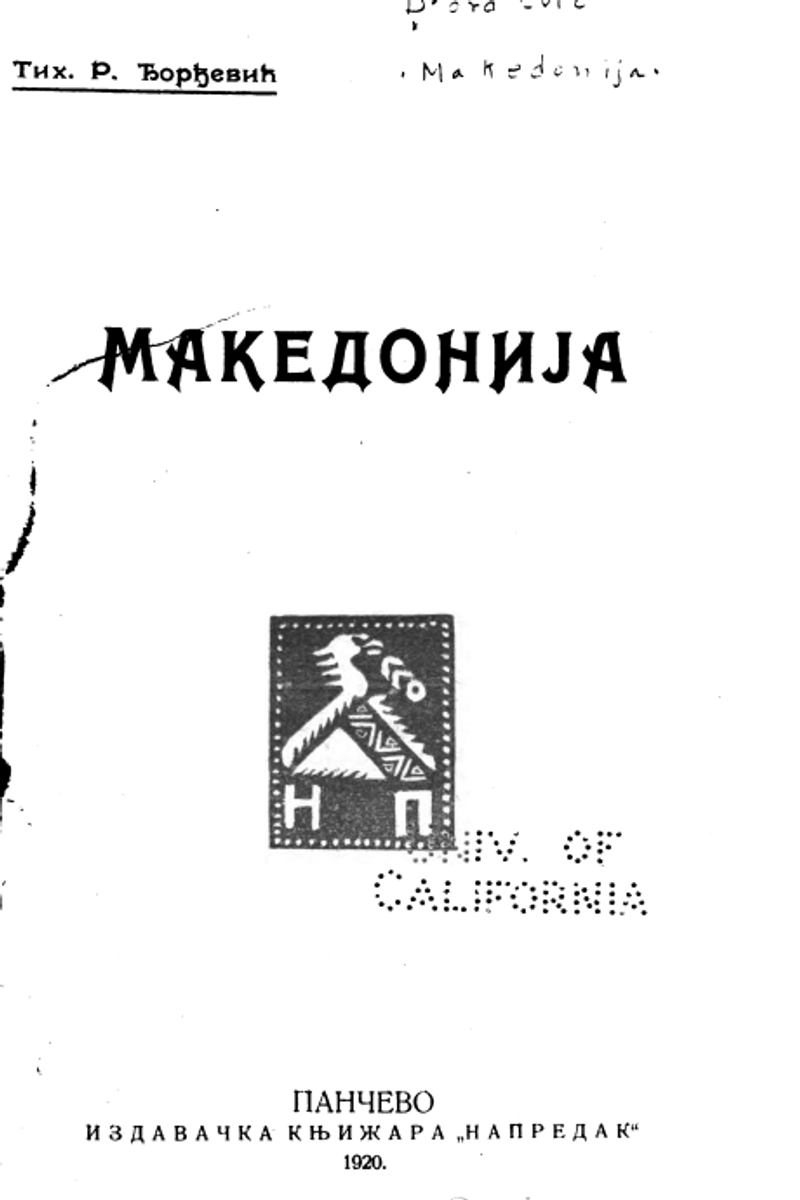
Македонија (1920)
Дела од Тихомир Ѓорѓевиќ


Пристап до книгата
Опис
Tihomir Đorđević's book, Macedonia, was written to address the political and national confusion surrounding the region of Macedonia in the early 20th century. The author contends that the concept of Macedonia was expanded by various writers, especially Bulgarians, for their political interests. Đorđević aims to provide a factual basis for the discussion, encouraging readers to form their own conclusions based on the evidence presented in the book. The book focuses on what the author considers the "true" boundaries of Macedonia and the national identity of its Slavic inhabitants, contrasting it with what is referred to as the "average Bulgarian understanding of the concept of Macedonia".
From the author's perspective, Macedonia is more than a geographical region; it is the "cradle" of Serbian Christianity, literacy, and civilization. He argues that the region was a culmination of the Serbian Empire's political and military power, the home of its patriarchate, and the origin of Dušan's Code. The author portrays Serbian rule in Macedonia not as a conquest, but as a liberation. The book emphasizes the shared cultural and historical bonds between Serbs and Macedonians, noting that the people of the region referred to their land as "Serbian land" and actively resisted Bulgarian propaganda and terror in the late 19th century.
In its conclusion, the book suggests that the Bulgarian expansionist claims over Macedonia were a deliberate "seizure of another's lawful right". The author quotes a prominent Bulgarian politician who acknowledged that Macedonians "lacked national (of course, Bulgarian) consciousness" before the establishment of the Bulgarian Exarchate. The book also draws on shared folklore, such as the hero Marko Kraljević, to argue for the historical and cultural unity of the Serbian and Macedonian people. Ultimately, the author's work serves as a defense of Serbia's claim to Macedonia based on historical and ethnic arguments.
За авторот
Author