Loading...
1532
Латински
За потеклото и славата на Словените (1532)


Пристап до книгата
Опис
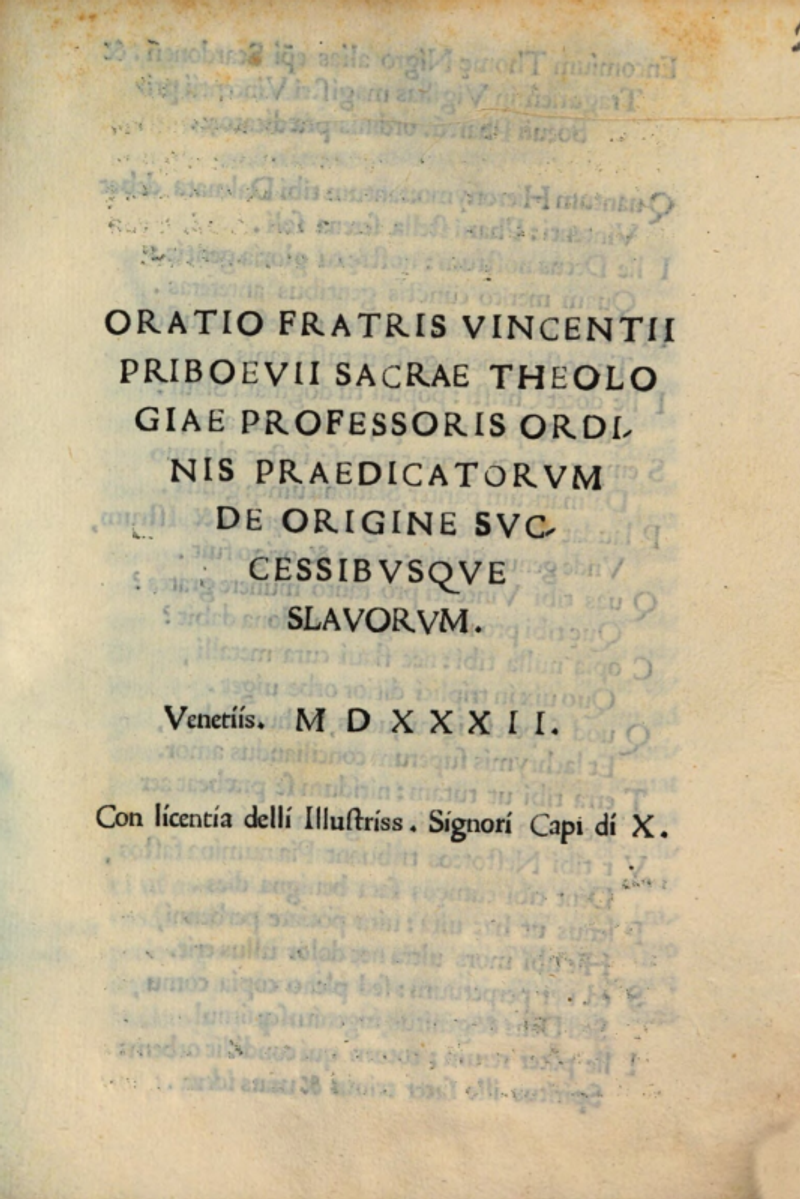
Vinko Pribojević, a Dominican friar and humanist from Hvar, delivered De origine successibusque Slavorum in Venice in 1525, with the Latin text first printed in 1532. In this eloquent humanist oration, Pribojević sets out to prove the antiquity, unity, and greatness of the Slavic peoples. Drawing upon ancient authors, biblical references, and mythological traditions, he claims that the Illyrians, Thracians, and Macedonians were all Slavs, and that many renowned historical figures, including Alexander the Great, certain Roman emperors, and Saint Jerome, belonged to the Slavic race.
The Latin text reflects the scholarly and rhetorical conventions of the Renaissance: ornate classical phrasing, citations from Greco-Roman historians, and moral exempla intended to inspire civic virtue. Pribojević positions the Slavs not as latecomers to history, but as participants in—and shapers of—the great civilizations of antiquity. His reinterpretation of ethnographic and historical records is clearly aimed at elevating the cultural prestige of the Slavs in the eyes of a Venetian audience, while also strengthening the self-image of his compatriots.
In essence, the Latin original is both a work of historical myth-making and an expression of early Slavic nationalism. While its historical claims lack modern scholarly accuracy, its rhetorical power and vision of a shared Slavic past make it a landmark in the intellectual history of South-Eastern Europe. It also foreshadows later panslavist thought and the cultural strategies of the 19th-century Illyrian Movement, making it a crucial text for understanding the early modern construction of Slavic identity.
За авторот
Author
Винко Прибојевиќ(1450 - 1532)