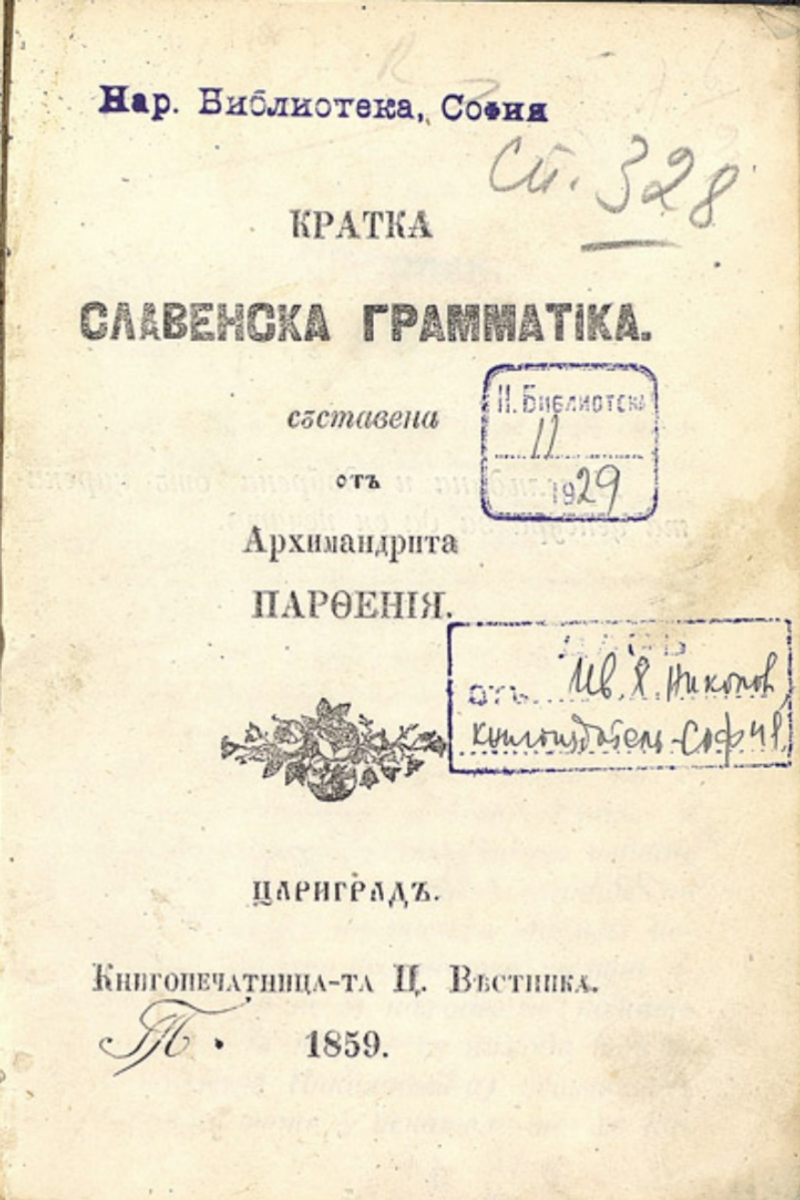
1859
Bulgarian • Macedonian
A Short Slavic Grammar
More by Parteniy Zografski

Access Book
Note
This work has been sourced from the Macedonian Academy of Sciences and Arts (MANU). The materials are used for scholarly, educational, and cultural-historical purposes, in support of the preservation, study, and promotion of Macedonian cultural heritage.
The original source is available via the project’s official web portal: Digital Resources of the Macedonian Language.
Description
"A Short Slavic Grammar" by Parteniy Zografski is a mid-19th-century educational work aimed at teaching and standardizing the Slavic language for students and the broader public in Macedonia. It bridges the gap between traditional liturgical language and the everyday speech of the local population.
The Old Church Slavonic sections used the traditional, highly formal Slavic liturgical language, rich in archaisms and grammatical forms preserved from medieval translations of the Bible and ecclesiastical texts. This part of the text followed the rigid syntax and vocabulary familiar from religious services, giving the work an air of authority and continuity with Orthodox Christian tradition.
The local Macedonian language portions reflected the spoken dialect of the Ohrid-Struga region in the mid-1800s. This was far more phonetically based, with simplified grammar, vocabulary rooted in everyday life, and orthography adapted to represent the actual pronunciation of Macedonian speakers. Zografski’s deliberate use of both languages served two purposes: to connect children to their religious and cultural heritage through Old Church Slavonic and to ensure practical literacy and comprehension through their native tongue. This mix also made the primer an important document in the history of Macedonian language standardization.
About the Author
Author
Parteniy Zografski(1818 - 1876)