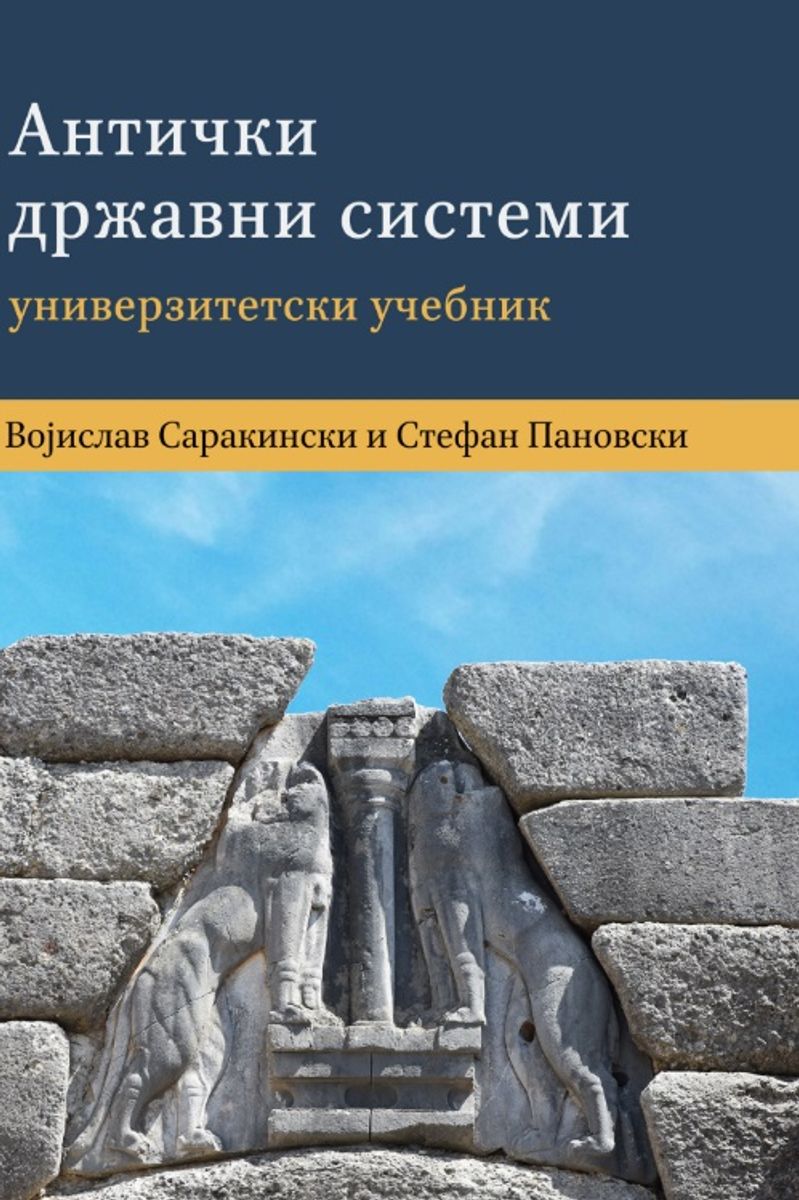
2019
Macedonian
Ancient State Systems
Access Book
Note
This work has been sourced from the Academia.edu website. The materials are used for scholarly, educational, and cultural-historical purposes, in support of the preservation, study, and promotion of Macedonian cultural heritage.
Description
Ancient State Systems (Антички државни системи) by Vojislav Sarakinski and Stefan Panovski is a 2019 university textbook that opens by defining what a state is, tracing the roots of modern statehood from the Greek polis through the Middle Ages to the sixteenth century concept of the state, and laying out rival normative theories: absolutist, constitutional, ethical, and pluralist. It frames these debates alongside a careful discussion of how historians, anthropologists, and political scientists study states in practice.
From there, the book becomes a guided tour of ancient governance: city-states of the Ancient Near East, early empires such as Akkad and Assyria, Pharaonic Egypt, the earliest European kingdoms of Minoan Crete and Mycenaean Greece, the Greek polis and its institutions, Sparta and Athens, the Macedonian kingdom, Hellenistic monarchies, and finally the Roman Republic and Roman Empire. Across these cases it dissects rulership, law, military organization, administration, economy, religion, and urban life, showing how different institutional choices produced durable political orders.
The concluding analysis weighs classic explanations for state formation such as class conflict, agricultural surplus, hydraulic management, warfare and conquest, environmental circumscription, and dependency networks of the ruler’s men of the king, and argues there is no single cause; rather, recurring mechanisms including security needs, infrastructure, surplus extraction, rivalry, and domination drive centralization. A synthetic table maps these triggers to theories, and the authors stress long-run convergence toward state forms, noting that by the mid-second millennium BCE states covered less than one percent of land yet housed about half of humanity, and by the start of the Common Era controlled around ten percent of land with roughly seventy-five percent of the world’s population.
About the Authors
Author
Vojislav Sarakinski is a Macedonian historian and professor at the Faculty of Philosophy, Saints Cyril and Methodius University in Skopje. His academic focus lies in ancient history, with particular attention to Macedonia, Greece, and the wider Hellenistic world. He has published extensively on topics such as political succession, identity, ethnicity, and historiography in antiquity. Sarakinski has authored and co-authored numerous scholarly works, contributing to both national and international journals, and is recognized for bridging detailed historical analysis with broader theoretical debates in ancient studies.
Author