1948
Bulgarian
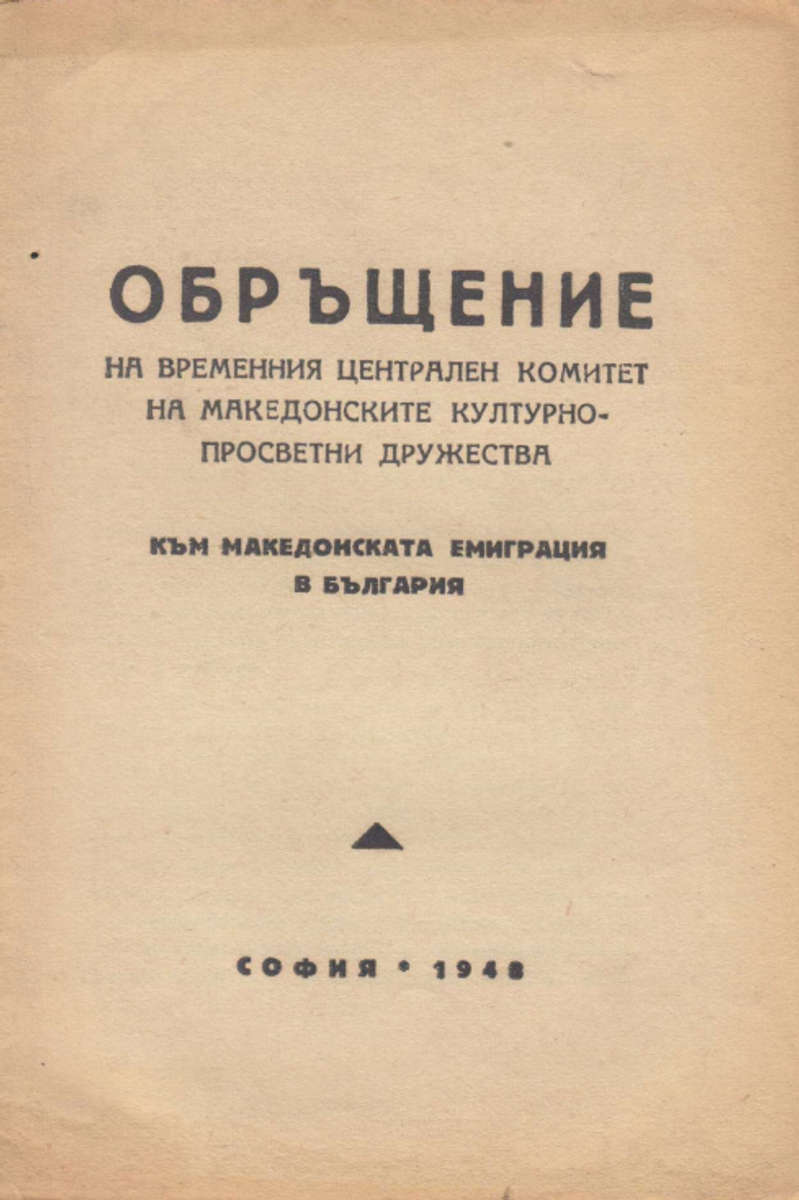
Appeal of the Temporary Central Committee of the Macedonian Cultural-Educational Societies to the Macedonian Emigration in Bulgaria
by Temporary Central Committee of the Macedonian Cultural-Educational Societies
Access Book
Description
Appeal to the Macedonian Emigration in Bulgaria, issued in Sofia in 1948 by the Provisional Central Committee of the Macedonian Cultural-Educational Societies in Bulgaria, is a political proclamation addressed to Macedonians living in Bulgaria during the period of post-war realignment in the Balkans. The text calls upon the Macedonian emigration to remain loyal to socialist principles and to resist what it describes as divisive influences emerging after the Stalin–Tito split. It frames the Macedonian question within the broader ideological confrontation unfolding between Yugoslavia and the Soviet bloc.
A significant portion of the appeal defends the recognition of a distinct Macedonian national identity and criticizes positions associated with Mihailovism and other currents portrayed as hostile to Macedonian national development. The document emphasizes solidarity with the People’s Republic of Macedonia and affirms the right of the population in Pirin Macedonia to cultural and national expression. It also incorporates resolutions concerning the status of the Pirin region and references contemporary political debates within the Bulgarian Communist Party.
The publication reflects the political and ideological context of 1948 and illustrates how the Macedonian question was addressed within the structures of socialist Bulgaria during the early Cold War period. As an official proclamation, it provides insight into the position of Macedonian cultural organizations in Bulgaria and into the intersection of national identity discourse and international communist realignments. It serves as a primary source for studying state-aligned rhetoric, organizational structures, and policy shifts affecting Macedonian communities in the immediate post-war years.
About the Institution
Institution
The Temporary Central Committee of the Macedonian Cultural-Educational Societies was formed in 1948 in Bulgaria to coordinate Macedonian émigré cultural and educational groups. It served as a transitional leadership body and issued appeals to the Macedonian diaspora, stressing unity, cultural preservation, and loyalty to socialist ideals.
By the early 1950s, it was reorganized under the control of the Bulgarian Communist Party, becoming the Union of Macedonian Cultural-Educational Societies in Bulgaria. This new structure replaced earlier independent societies, took over their property, and directed activities in line with communist ideology.
The Union promoted Macedonian national consciousness within a socialist framework, encouraged solidarity with Bulgarians, opposed Titoism and nationalism, and emphasized loyalty to the Soviet Union. In this way, Macedonian émigré culture in Bulgaria was placed firmly under state and party supervision.