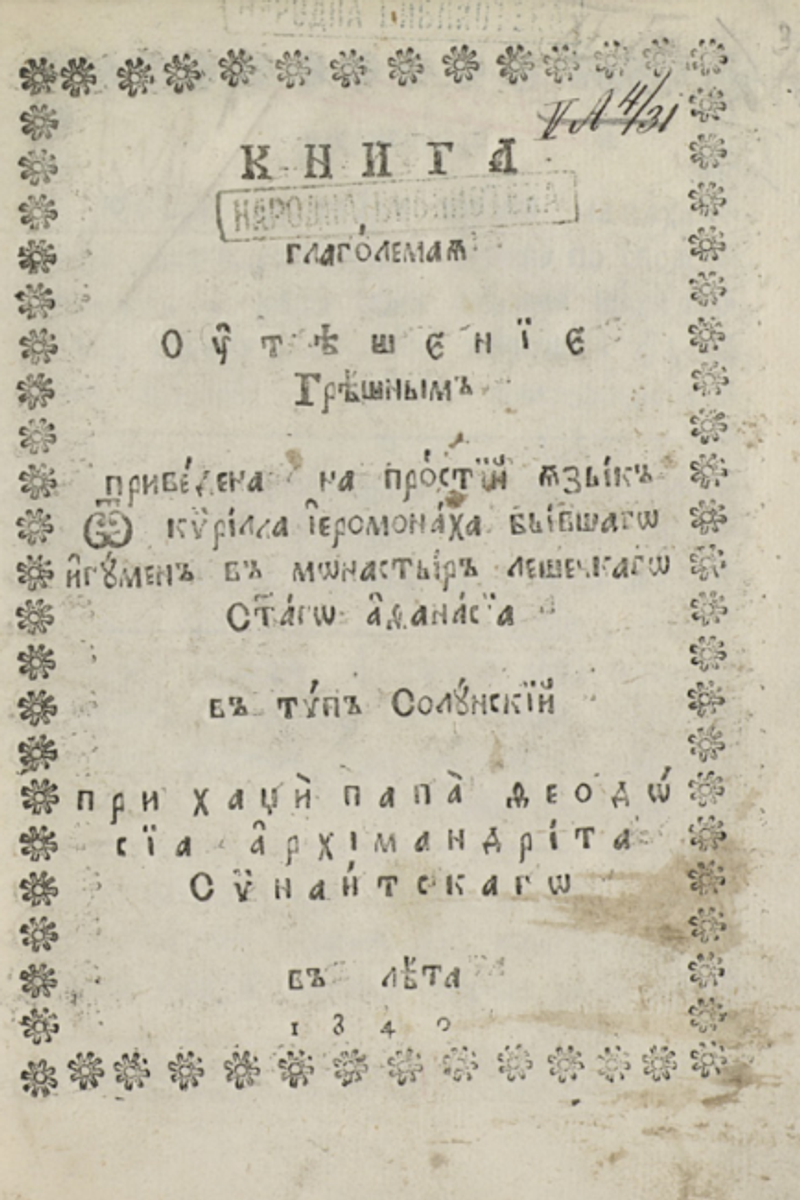
1840
Macedonian • Old-Church-Slavonic
Solace of the Sinner (1840)
More by Kiril Peychinovich


Access Book
Description
Solace of the Sinner (Утешение грешним), written by Kiril Peychinovich in the early 19th century, is a religious and moral guide aimed at ordinary believers. Composed in a Macedonian vernacular dialect with elements of Church Slavonic, it reflects Peychinovich’s effort to make spiritual teaching accessible to the local population. The book encourages repentance, humility, and devotion to God, explains Christian teachings, warns against sinful behavior, and offers spiritual advice for leading a righteous life, serving both as a moral compass and a source of comfort for those seeking forgiveness.
The Preface by Theodosius of Sinai to this book is the only known literary work by Theodosius. After Peychinovich failed to publish his book in Belgrade due to church censorship, he entrusted it to Theodosius, also helping him restore his burned printing press. In gratitude, Theodosius wrote the preface, which reveals his literary sensibility.
At the beginning, Theodosius reflects on humanity’s age-old desire to leave a lasting mark, contrasting rulers who built monuments for fame with teachers who wrote in a clear, vernacular Macedonian language to truly enlighten people. He likens this language to an “iron and steel key” that can open the hearts of ordinary folk, unlike gold or silver keys, which are too soft. This metaphor embodies his progressive stance as one of the first Macedonian printers, educators, and defenders of the Macedonian vernacular against the dominance of Greek in schools and the church.
Through the preface and his broader work, Theodosius emerges as an early visionary of the need for printed books to elevate the Macedonian literary language and culture.
About the Author
Author
Kiril Peychinovich(1770 - 1845)