1907
Bulgarian
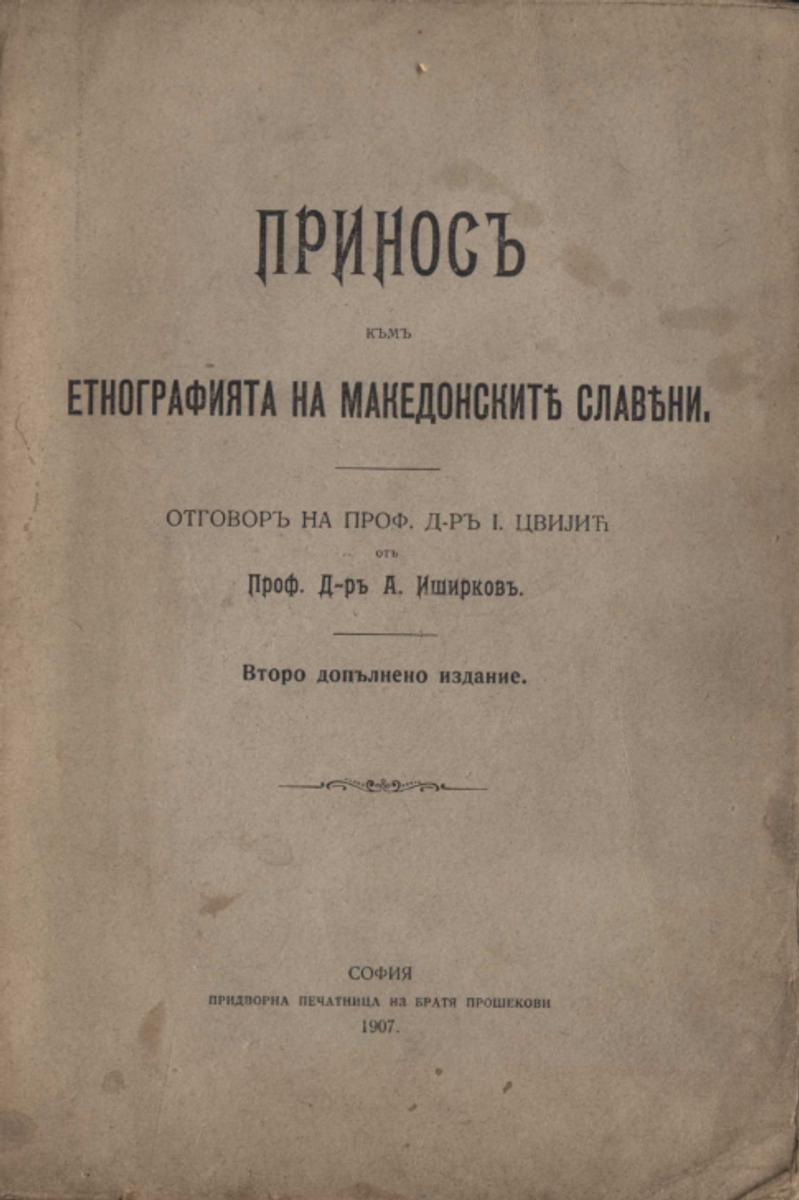
Contribution to the Ethnography of the Macedonian Slavs
Access Book
Description
Contribution to the Ethnography of the Macedonian Slavs by Atanas Ishirkov, published in Sofia in 1907 as a response to Prof. Ljubomir Cvijić, addresses the ethnographic classification of the Slavic population in Macedonia. The work engages in the early twentieth-century scholarly debate over the ethnic character of Macedonia’s inhabitants, drawing on linguistic, geographic, and historical arguments. Ishirkov challenges Serbian ethnographic claims and attempts to define the cultural and national identity of the Macedonian Slavs within a broader regional framework.
A central focus of the study is the interpretation of dialects, settlement patterns, and historical cartography. Ishirkov argues that linguistic features and historical continuity link the Slavic population of Macedonia to the Bulgarian national body, rejecting Serbian territorial-ethnographic interpretations advanced by Cvijić. The text situates Macedonia within what the author describes as a natural ethnographic space extending toward Bulgaria, presenting demographic and cultural data in support of this claim.
The work belongs to the tradition of Bulgarian nationalist historiography concerning Macedonian history. Written at a time of intense Balkan rivalry, it reflects the intellectual and political contest over Macedonia’s national affiliation prior to the Balkan Wars. At the same time, the booklet remains a significant historical source for understanding how ethnography, cartography, and linguistic scholarship were mobilized in early twentieth-century debates about identity and statehood in Macedonia.
About the Author
Author
Anastas Ishirkov(1868 - 1937)
Anastas Ishirkov was a Bulgarian geographer, ethnographer, university professor, academician of the Bulgarian Academy of Sciences, and founder of the Bulgarian Geographical Society. He is regarded as the founder of modern geography in Bulgaria and served as rector of Sofia University (1915–1916) and three times as dean of its Faculty of History and Philology.
Educated in Sofia, Leipzig, Berlin, and Nancy, Ishirkov studied under Friedrich Ratzel and Ferdinand von Richthofen, becoming a key promoter of anthropogeography and political geography in Bulgaria. He authored over 30 books and hundreds of studies in Bulgarian and foreign languages, including Hydrography of Bulgaria and Bulgaria: Geographical Notes. His work covered economic geography, settlement studies, hydrology, climatology, geomorphology, and ethnography.
Ishirkov devoted significant research to Macedonia, combining fieldwork with ethnographic and political studies. He opposed Serbian geographer Jovan Cvijić, defending the Bulgarian national character of the region’s population. His writings on the cultural-political geography of Macedonia and Southern Thrace were influential both academically and in Bulgaria’s diplomatic efforts during and after the Balkan Wars and World War I.
A respected public figure, Ishirkov took part in scientific expeditions, cultural missions abroad, and represented Bulgaria at international congresses. He was decorated with several national orders and was a major benefactor to Sofia University, donating his library and endowment funds to support geographical research. Today, streets, institutions, and memorials in Bulgaria commemorate his contribution to science and national culture.