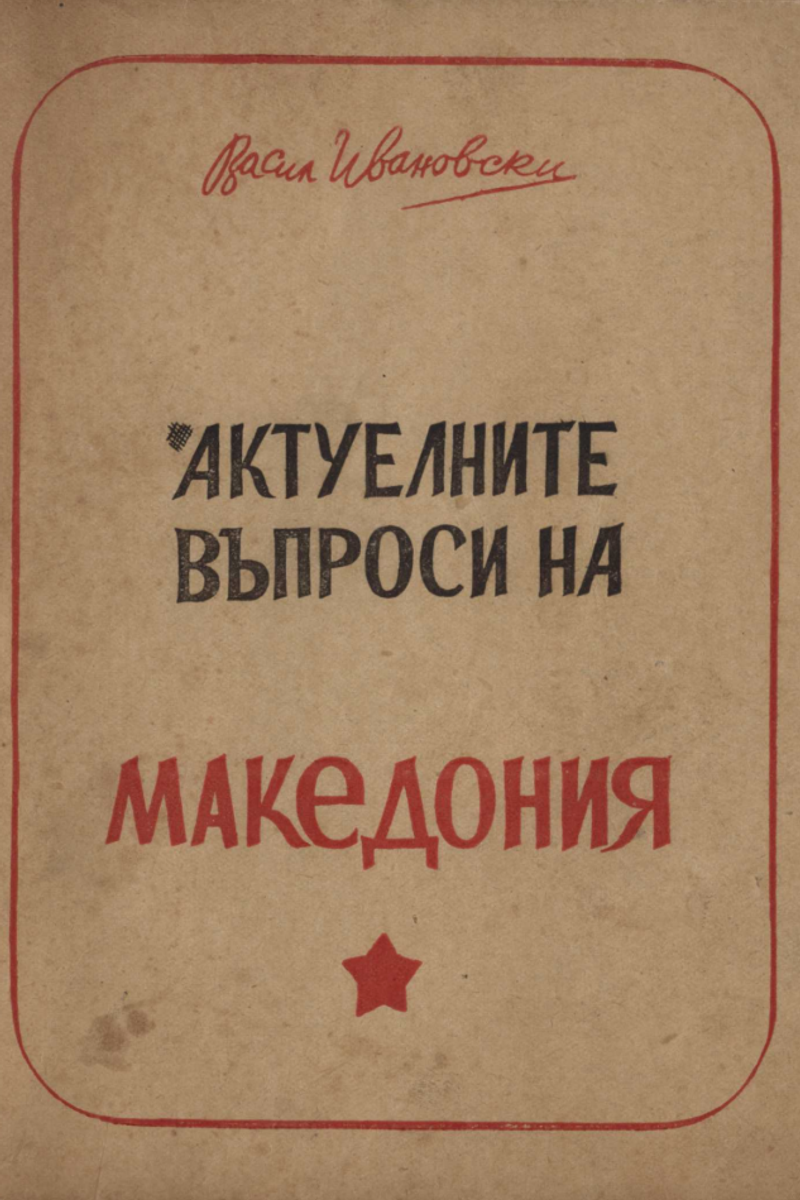
1946
Bulgarian
Current Issues of Macedonia
Access Book
Description
The Current Questions of Macedonia by Vasil Ivanovski, published in 1946, is a political analysis written in the immediate post–Second World War context. The work addresses the status of Macedonia after the defeat of fascism and the creation of the Federal People’s Republic of Yugoslavia. Ivanovski argues that the Macedonian people have achieved a historic breakthrough through the establishment of a Macedonian republic within the Yugoslav federation, framing this development as the result of long revolutionary struggle and anti-fascist resistance.
A central theme of the booklet is the recognition of the Macedonian nation, the Macedonian language, and the right to cultural and political self-determination. Ivanovski directly engages debates in Bulgaria regarding whether Macedonians are a separate people or part of the Bulgarian nation. He rejects claims that deny Macedonian distinctiveness and criticizes positions advocating annexation or revision of postwar borders. Several sections (pp. 10–18; 26–33) explicitly defend the legitimacy of the Macedonian republic and emphasize the role of the Anti-Fascist Assembly for the National Liberation of Macedonia (ASNOM) in institutionalizing national rights.
The publication reflects the political and ideological framework of the immediate postwar Balkan settlement and illustrates how the Macedonian question was interpreted within debates about federalism, minority rights, and regional stability. Written in 1946, it provides insight into the early consolidation of Macedonian statehood within Yugoslavia and into contemporary discussions concerning relations between Yugoslavia and Bulgaria. As a political pamphlet, it serves as a primary source for studying postwar identity formation and the restructuring of national narratives in Southeast Europe.
About the Author
Author
Vasil Ivanovski(1906 - 1991)