1999
Macedonian
Dimitar V. Makedonski


Access Book
Note
This work has been sourced from the Macedonian Academy of Sciences and Arts (MANU) and Wikimedia Commons. The materials are used for scholarly, educational, and cultural-historical purposes, in support of the preservation, study, and promotion of Macedonian cultural heritage.
The original source is available via the project’s official web portal: Wikimedia Commons.
Description
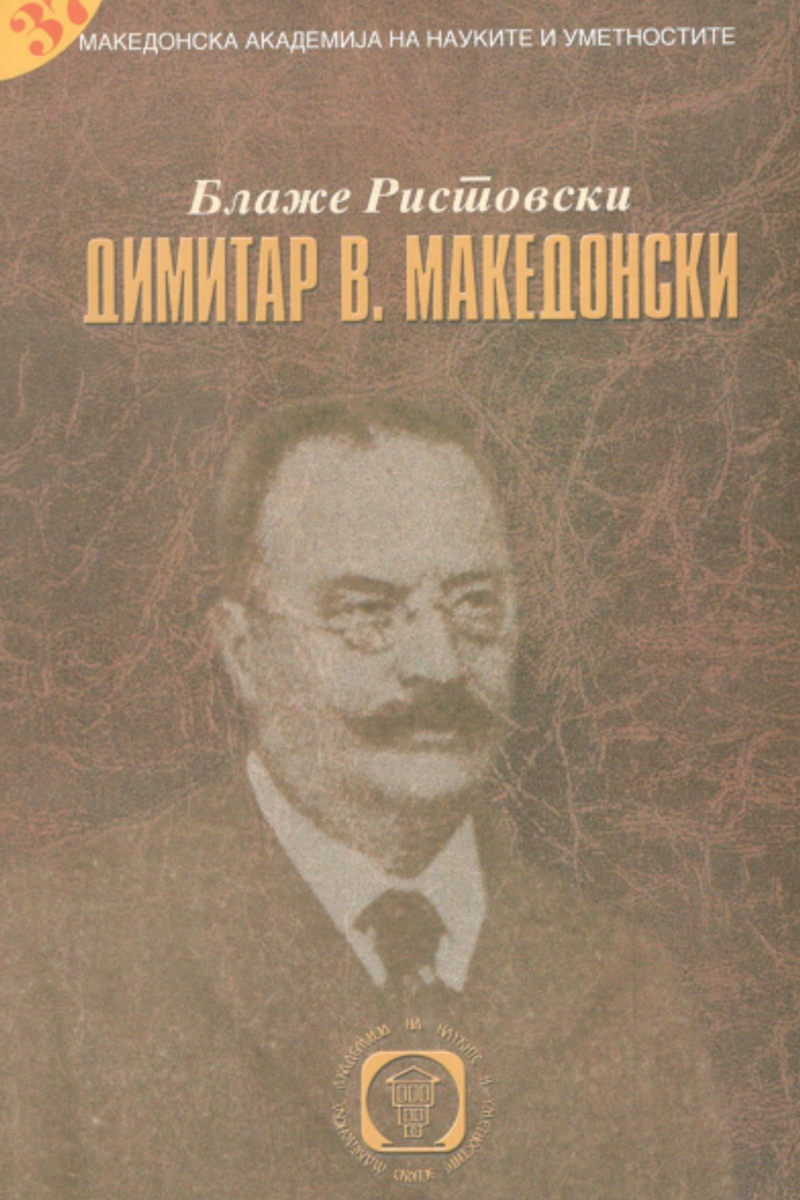
Dimitar V. Makedonski is a biographical and historical monograph written by Macedonian historian Blaže Ristovski and published in 1999 on the occasion of the 150th anniversary of Dimitar Makedonski’s birth and the 100th anniversary of his death. The work was issued by the Macedonian Academy of Sciences and Arts (MANU) and focuses on the life, work, and historical significance of Dimitar Vasilev Makedonski, a prominent 19th-century Macedonian teacher and cultural figure. This book places Makedonski within the broader narrative of Macedonian national and cultural history, emphasizing his contribution to the development of national awareness and education among Macedonians.
In the study, Ristovski explores Makedonski’s educational activities, his role in the cultural and national awakening of the Macedonian people under Ottoman rule, and his efforts to strengthen Macedonian identity at a time of intense competition among neighboring national movements. Ristovski situates Makedonski against the backdrop of Balkan 19th-century transformations, showing how his teaching and intellectual engagements contributed to the early formation of Macedonian cultural consciousness. The narrative is supported by archival documents, personal correspondences, and contemporary testimonies, making it both a scholarly biography and a source of historical evidence.
The book also reflects Ristovski’s methodological approach as a historian, which emphasizes cultural continuity and spiritual history in tracing the evolution of the Macedonian people. Rather than focusing solely on political events, Ristovski highlights how figures like Makedonski helped sustain and transmit Macedonian language, tradition, and collective identity through education and cultural activism. Through this lens, the monograph not only commemorates an individual but also contributes to the broader understanding of how Macedonian national identity developed in the 19th century.
About the Author
Author
Blaže Ristovski(1931 - 2018)
Blaže Ristovski was one of the most influential Macedonian historians, philologists, folklorists, and scholars of national and cultural history. Born in the village of Garnikovo near Kavadarci, he came from a family deeply involved in the Macedonian national liberation movement. From an early age, he participated in the anti-fascist struggle during World War II and later experienced political persecution, including imprisonment in 1948—events that shaped his lifelong commitment to the Macedonian national question and cultural identity.
Ristovski completed his studies at the Faculty of Philology in Skopje and earned his PhD in 1965 with a dissertation on Krste P. Misirkov. His academic career spanned key institutions: he served as director of the Institute of Folklore, scientific advisor at the Institute of National History, and later at the Institute for Old Slavic Culture. He also taught Macedonian language and literature in Slovenia and played a central role in organizing systematic fieldwork for collecting Macedonian folklore, founding the journal Macedonian Folklore, and establishing the International Symposium on Balkan Folklore in Ohrid.
Beyond academia, Ristovski held important public responsibilities. He was elected Vice President of the first government of independent Macedonia in 1991 and later served as Secretary of the Macedonian Academy of Sciences and Arts (MANU). As editor of the first Macedonian Encyclopedia and author of dozens of books and over 800 scholarly articles, Blaže Ristovski made a lasting contribution to the study and affirmation of Macedonian language, literature, folklore, and national consciousness.