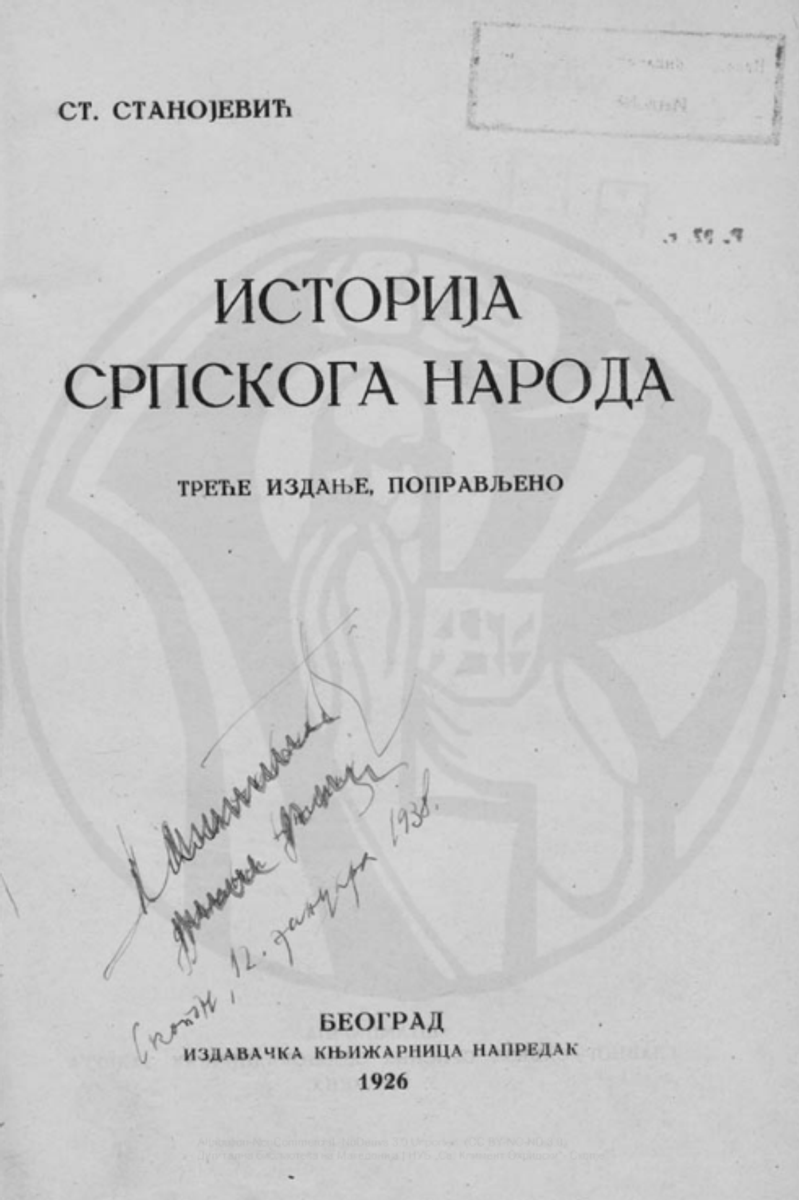
1926
Serbian
History of the Serbian People (1926)
More by Stanoje Stanojević

Access Book
Description
Stanoje Stanojević, a prominent Serbian historian and professor, authored the third edition of History of the Serbian People in 1926, a comprehensive work that traces the origins and development of the Serbs from ancient times to the early 20th century. The book emphasizes the unity of the Serbian nation, incorporating regions like Bosnia into its narrative and highlighting the Serbs' interactions with major empires such as Byzantium and the Ottomans. Stanojević's scholarship draws on extensive sources to portray the Serbs as a resilient people with a rich cultural heritage, influenced by his broader works on topics like Byzantium and the Serbs and Saint Sava.
The narrative begins with the migration of Slavs to the Balkans in the early medieval period, detailing the establishment of the first Serbian principalities under the Vlastimirović dynasty around the 8th century. It covers the rise of powerful medieval states, including the Nemanjić dynasty's empire, the role of the Orthodox Church, and conflicts with neighboring powers. Stanojević explores cultural and religious developments, underscoring the impact of Catholicism and Orthodoxy on Serbian identity during the Middle Ages.
In later sections, the book examines the Ottoman conquest, the long period of Turkish rule, Serbian uprisings in the 19th century, and the path to independence and unification efforts leading into the 20th century. Stanojević's work reflects a nationalistic perspective, aiming to foster a sense of shared history among Serbs and South Slavs, which influenced Yugoslav ideas during his era. Though dated, it remains a foundational text in Serbian historiography, with ongoing relevance in discussions of Balkan identities.
About the Author
Author
Stanoje Stanojević(1874 - 1937)