2026
Macedonian
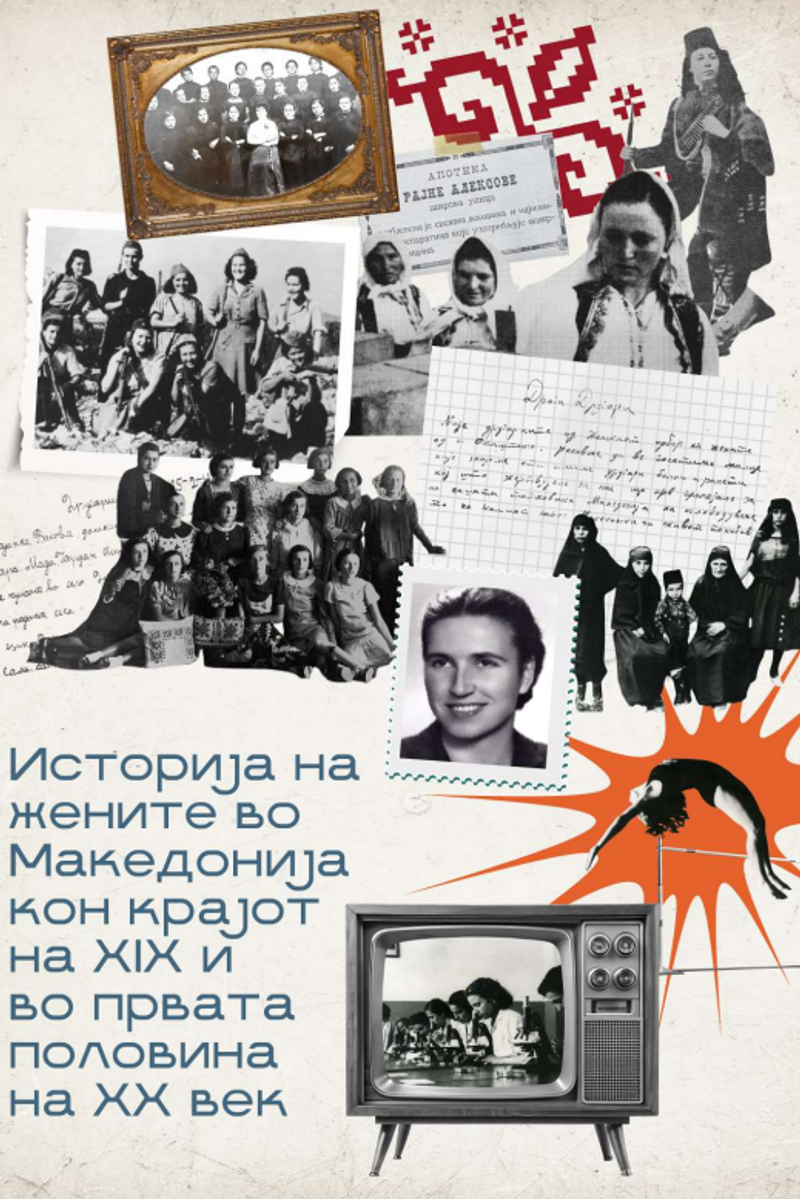
History of women in Macedonia towards the end of the XIX and the first half of the XX century
by Petar Todorov, HERA – Health Education and Research Association, Tiiiit! Inc.
Access Book
Note
This work has been sourced from HERA – Health Education and Research Association. The materials are used for scholarly, educational, and cultural-historical purposes, in support of the preservation, study, and promotion of Macedonian cultural heritage.
Description
History of Women in Macedonia in the Late 19th and Early 20th Century is a historical reader that explores the roles, experiences, and activities of women in key social and political processes of this period . The work covers the late Ottoman era, the rise of national movements, the wars, and the creation of the Macedonian state in 1944.
Particular attention is given to the participation of women in the revolutionary movement, during the Ilinden period and the National Liberation Struggle, as well as their role in education, healthcare, and labor movements. The reader demonstrates that women were active participants in political and social developments despite the constraints of a patriarchal society.
At the same time, the book has a clear pedagogical purpose, encouraging critical thinking through the use of historical sources, testimonies, and visual materials. As a source, it represents an interdisciplinary effort to expand the historiographical narrative and to include the women’s perspective in Macedonian history.
About the Authors
Author
Prof. PhD Petar Todorov is a Macedonian historian and full professor at the Institute of National History in Skopje, at Ss. Cyril and Methodius University. His academic work focuses on the Ottoman and post-Ottoman Balkans, Ottoman heritage in modern nation-states, the public use and misuse of history, and history education and textbooks.
He earned his BA in history in Skopje, completed advanced studies in Paris, and received his PhD in 2013 with research on Skopje during the final century of Ottoman rule. Over the years, he has also worked as a visiting researcher and professor in Tirana and Istanbul.
Beyond teaching and research, Petar Todorov has taken part in major regional and international academic initiatives. He is involved in bodies connected to history teaching, Holocaust remembrance, and historical dialogue in Southeast Europe. His publications and conference work show a strong interest in historiography, identity, memory, nationalism, and the political use of the past in the Balkans.
Institution
HERA is a Macedonian civil society organization founded in 2000. It works in the field of sexual and reproductive health and rights, health education, gender equality, and support services for vulnerable groups. Over time, it has grown from an HIV-awareness initiative into a major organization that combines education, advocacy, and direct health and social services in Macedonia.
Institution
Tiiiit! Inc.(2011)
Tiiiit! Inc. is a Macedonian civil society organization rooted in feminist activism. It was founded in 2011 as an informal group and later registered in 2014 as a nonprofit organization. Its work is focused on women’s rights, gender equality, reproductive rights, feminist culture, and support for marginalized communities.
Over time, Tiiiit! Inc. has grown from a grassroots feminist initiative into a visible organization that combines activism, cultural production, public advocacy, and community-based work in North Macedonia. Its activities promote feminist values in society and create space for women’s voices, artistic expression, and social engagement.