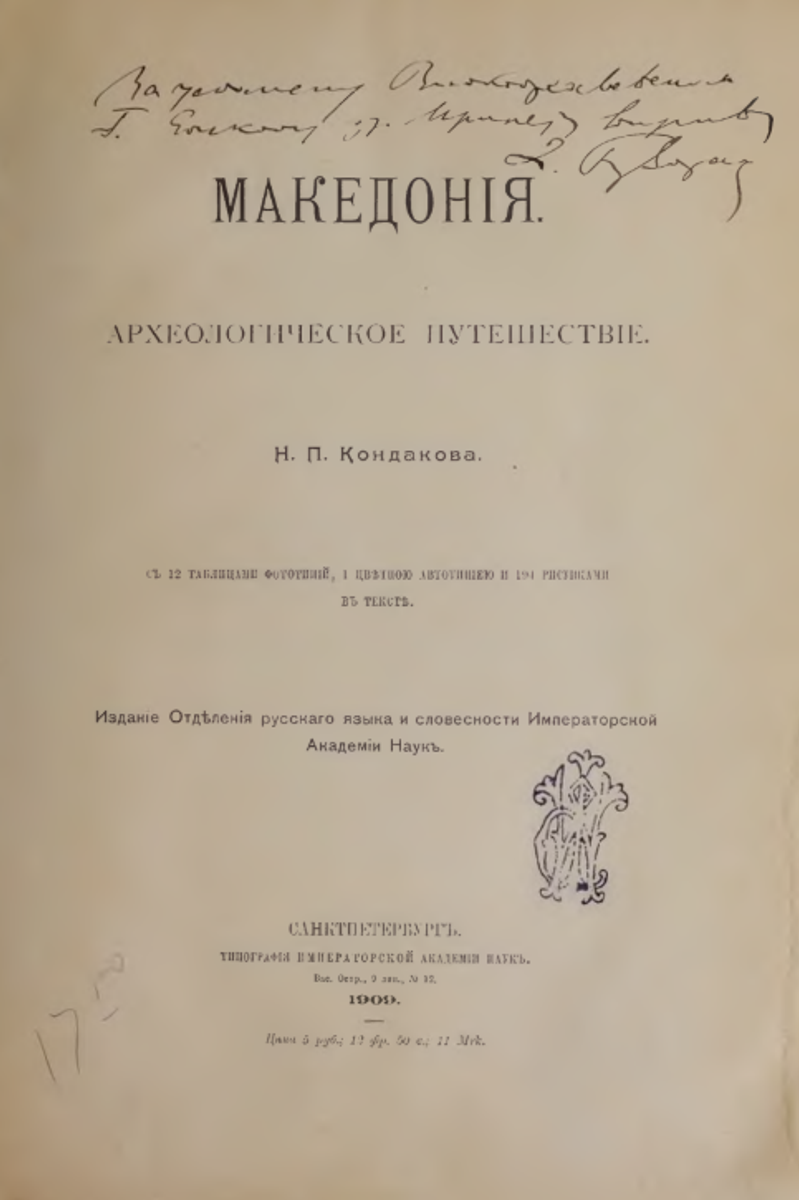
1909
Russian
Macedonia: An Archaeological Journey
Access Book
Description
"Macedonia: An Archaeological Journey" published in 1909, is a report on a historical and ethnographic expedition to Macedonia. The expedition was organized by the Imperial Academy of Sciences and took place in the summer of 1909. The main goal of the expedition was to collect materials for a future historical and ethnographic study of Macedonia, particularly to establish historical, archaeological, and philological foundations to help resolve the major political question of Macedonia's status within the Ottoman Empire.
The book is structured as a travelogue, detailing the team's observations in various regions. It includes chapters on Thessaloniki, the city of Serres, Skopje and its surroundings, and Bitola-Ohrid. It also contains an album of photographs from the expedition, and a subject index.
Kondakov states that travel within the country was difficult and that the political situation was grim, with the central Vardar river valley being a cultural battleground between Slavic and Greek populations. The author also notes the increasing influence of Islam due to the systematic settlement of Turkish and Albanian populations.
The book's introduction provides a historical overview of the Slavic settlement of the Balkan Peninsula. The author argues that the Slavic population in Macedonia is "completely whole, unified, and quite original".
The book is an important historical and archaeological record of Macedonia at the turn of the 20th century.
About the Author
Author
Nikodim Kondakov(1844 - 1925)