2021
Macedonian
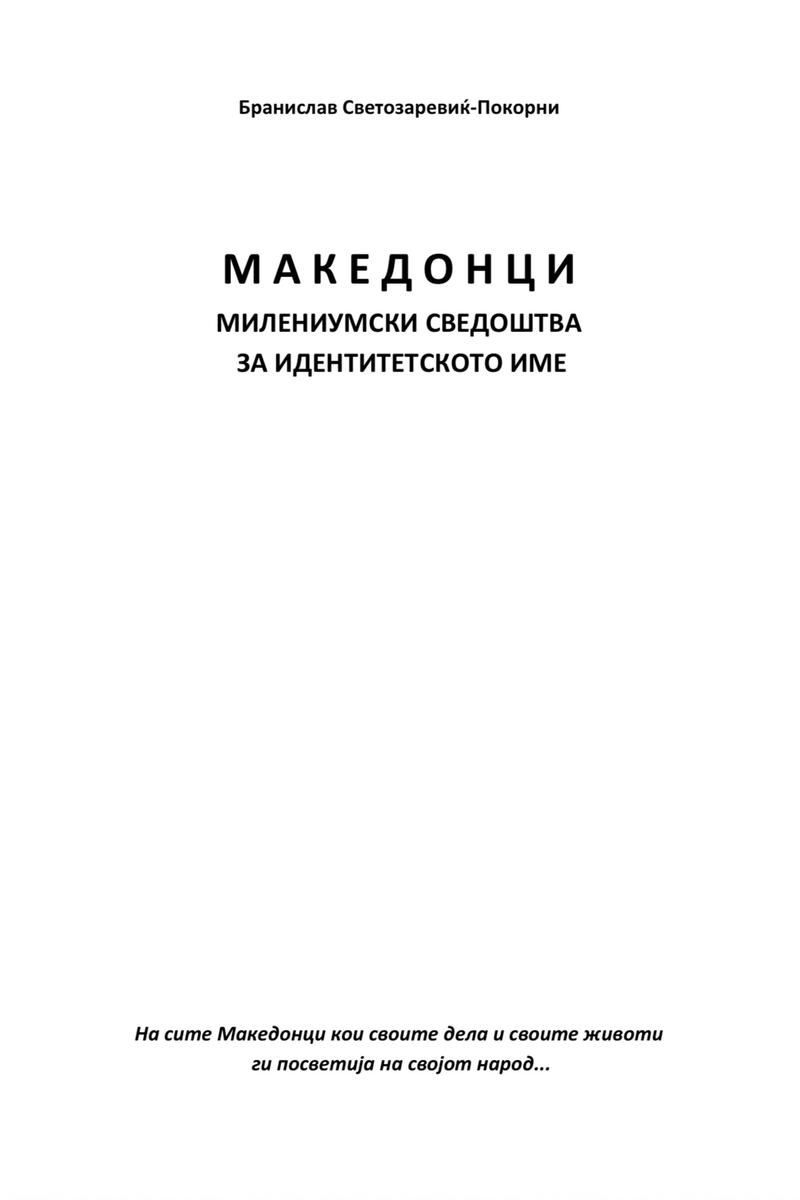
Macedonians – Millennium-long Testimonies to the Ethnic Name
Access Book
Note
This work has been made available with the consent of the author. The materials are used exclusively for scholarly, educational, and cultural-historical purposes, in support of the preservation, study, and promotion of Macedonian cultural heritage.
Description
Macedonians – Millennium-long Testimonies to the Ethnic Name by Branislav Svetozarević-Pokorni, is a study and a collection of sources that explores the historical name and identity of the contemporary Macedonian people. The author's motivation for the book stems from the modern political pressures that challenge the continuity of the Macedonian nation and its name. The core thesis of the work is that the Macedonian people are "just Macedonians" and that their ethno-cultural identity is a unique blend of ancient and Slavic roots. The book argues against the claims that Macedonians are Greek or Bulgarian, and posits that a people cannot be invented or erased by political decrees.
The book is structured to provide a chronological account of the name "Macedonians" from antiquity to the present day. It details how the name of the ancient Macedonian people and the land of Macedonia were preserved even after Roman rule. The study highlights three forms of self-identification: territorial, ethno-historical, and national. The author argues that the territorial identity of Macedonians, derived from their land, has endured since the Middle Ages, with the name re-emerging in sources from the 12th century onwards. The book documents how this identity persisted even as the name was at times suppressed, denied, or co-opted, and despite the assimilation of other groups into the Macedonian ethnic community over time. The author also provides numerous quotes from various sources, including prominent Macedonian figures like Boris Sarafov and Nikola Karev, who emphasized that Macedonians are distinct from Serbs and Bulgarians and that Macedonia belongs to the Macedonians.
The book also covers the period of the 19th and 20th centuries, focusing on the emergence of an ethno-historical and then a national self-awareness among Macedonians. It examines the negative impact of foreign propaganda from neighboring states like Serbia, Greece, and Bulgaria on the development of the Macedonian national identity. The author provides sources that show how foreign powers and historical commissions, such as the Carnegie Commission, acknowledged the distinct identity of the Macedonian people. The book concludes that the Macedonian people's struggle for independence and their rejection of being annexed by other countries demonstrates their unique national character and resilience. It concludes by affirming the existence of a distinct Macedonian nation with its own history, language, and culture.
About the Author
Author
Branislav Svetozarevikj Pokorni is a Macedonian historian, archivist, and publicist. He is noted for his research on the cultural and political history of Macedonians, with particular focus on Tetovo and the wider region, as well as for his contributions to the preservation of archival and historical heritage.
Svetozarevikj was born in Skopje and raised in Tetovo. He studied history at the Faculty of Philosophy, Ss. Cyril and Methodius University of Skopje, where he graduated in 1994. He obtained a master’s degree in 2007, focusing on archival studies, and earned his Ph.D. in historical sciences in 2013 with a dissertation on the socio-political and cultural life of Macedonians in Tetovo during the early 20th century.
In 1992, he began working at the State Archives of Macedonia, serving in various capacities including deputy head of archival protection. From 2010 to 2018, he was the acting director and later the first director of the Museum of the Macedonian Struggle for Statehood and Independence. Since 2015, he has held the academic title of Assistant Professor at the Institute of National History in Skopje.
Svetozarevikj has published around 20 scholarly papers and authored several monographs, including Serbian and Bulgarian Church-Scholastic Propaganda in Tetovo and the Tetovo Region (1860–1903) (1996), Tetovo Almanac 1919–1941 (1999), and a study of the Lešok Monastery complex (2001). His major work, Macedonians – Millennium-long Testimonies to the Ethnic Name (2023), presents over 1,000 historical documents from 32 countries affirming the continuity of Macedonian identity. An English edition was also released in 2023.
In addition to academic work, Svetozarevikj is active in public discourse, frequently addressing issues of Macedonian identity and historiography. He has organized exhibitions, contributed to media programs, and is known for his outspoken defense of Macedonian cultural and national heritage.