1949
Bulgarian
Nationalism of the Skopje Leaders
Access Book
Description
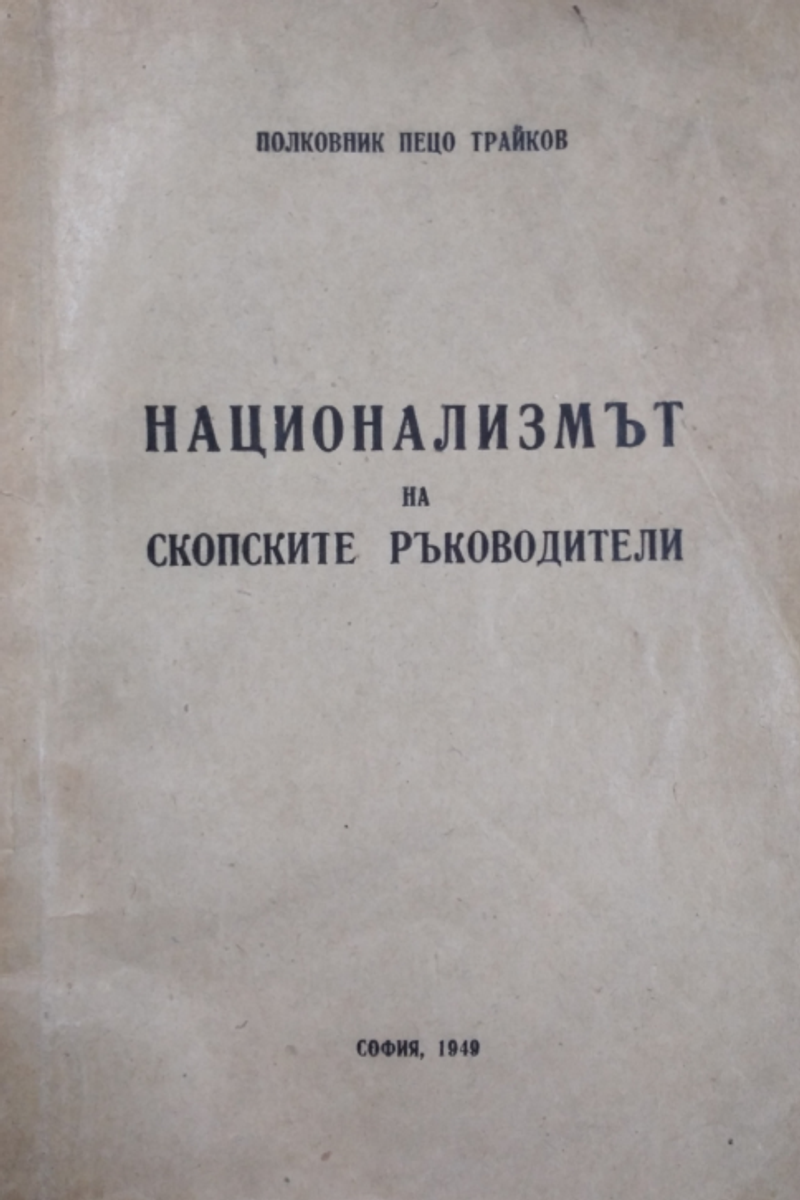
The Nationalism of the Skopje Leaders by Col. Petso Traikov, published in Sofia in 1949, is a polemical political brochure addressing developments in the People’s Republic of Macedonia within socialist Yugoslavia. Written in the aftermath of the Stalin–Tito split, the work criticizes the leadership in Skopje for what the author describes as nationalist deviation and hostility toward Bulgaria. The text situates the Macedonian question within the broader ideological conflict between Yugoslavia and the Soviet bloc.
Traikov argues that the policies of the Skopje authorities represent a betrayal of socialist internationalism and a distortion of historical ties between Macedonia and Bulgaria. Particular attention is given to interpretations of the Macedonian national identity, the organization of partisan forces, and the role of Bulgarian communists in the liberation struggle. The author maintains that the Macedonian revolutionary movement historically belonged to the Bulgarian national sphere and accuses Yugoslav leaders of rewriting that legacy.
The publication presents Macedonian developments through a framework shaped by post-1948 Bulgarian political and ideological positions. Written in the immediate context of the Stalin–Tito split, it reflects the tensions between Sofia and Belgrade and situates the Macedonian question within that broader confrontation. As a contemporary political document, the brochure provides insight into how national identity, historical legacy, and revolutionary memory were interpreted within Bulgarian communist discourse at the time. It therefore serves as a valuable source for understanding the intersection of ideology, geopolitics, and identity debates in the early Cold War Balkans.
About the Author
Author
Petar (Petso) Traykov(1896 - 1964)
Petar Traykov was a Macedonian revolutionary and national activist from the village of Vrbjani, Lerin (today Florina, Greece). He completed his education in Bitola, and after the Balkan Wars emigrated to Bulgaria, where he attended a military academy. During World War I he served as an officer on the Macedonian front in the Bulgarian army.
After the war, he joined the Internal Macedonian Revolutionary Organization (IMRO) and operated as a voyvoda in Lerin, Prespa, and Ohrid. In 1924 he formed his own detachment in Aegean Macedonia, while also maintaining connections with Albanian circles. Sentenced to death in absentia by the Greek authorities, he fled to Albania and later to Bulgaria, where he was active in the Macedonian Brotherhood in Sofia. He rose within IMRO ranks, eventually siding with the Protogerovists after the assassination of Alexander Protogerov, and later joined VMRO (United), cooperating with the left and the Workers’ Party.
During World War II, Traykov was imprisoned by Bulgarian authorities but released in 1944. He became commander of the Macedonian partisan brigade Goce Delchev and participated in the anti-fascist struggle. He was a delegate at the Second Session of ASNOM in Skopje in December 1944, which laid the foundations of Macedonian statehood. However, after political disputes with pro-Serbian leaders in Skopje, he returned to Bulgaria in 1948.