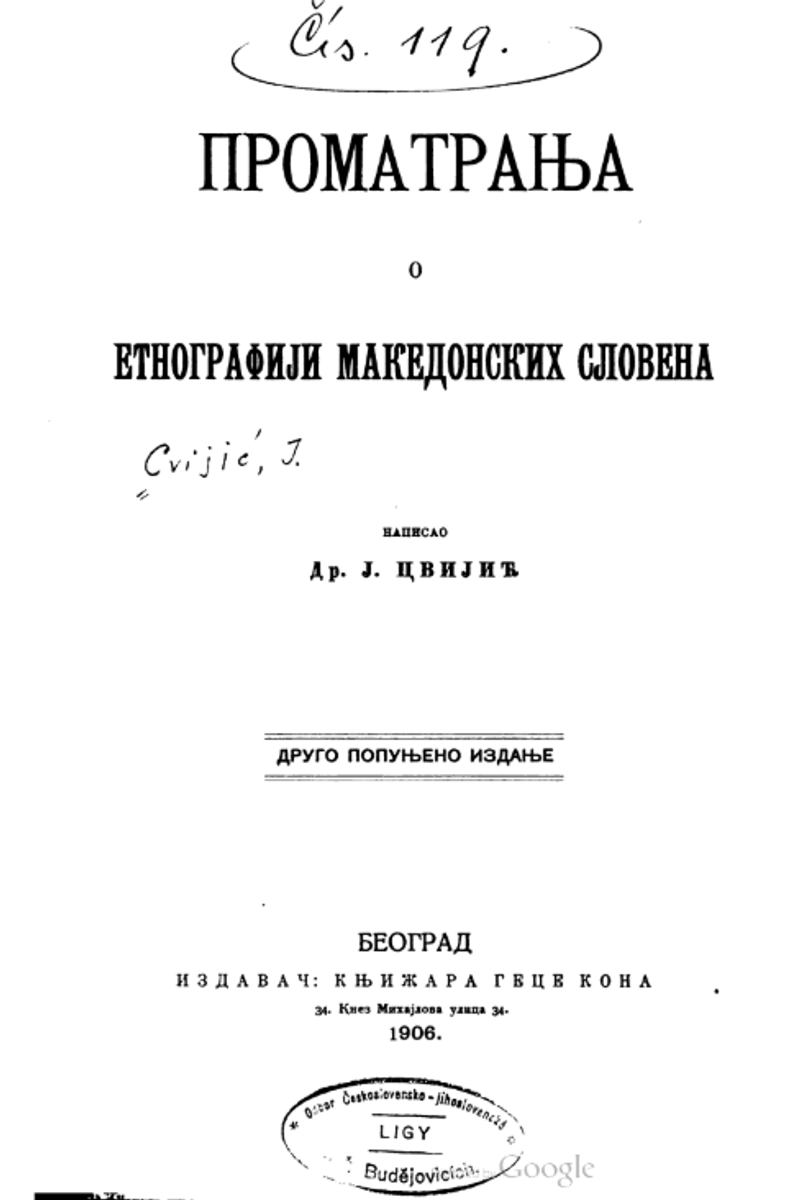
1906
Serbian
Observations on the Ethnography of Macedonian Slavs
by Jovan Cvijić
Access Book
Description
"Observations on the Ethnography of Macedonian Slavs" argues that the ethnicities in Macedonia are extremely mixed, particularly in the southern region. The author, Jovan Cvijić, asserts that the Macedonian Slavic population lacks a definitive national identity, a unique historical past, or a literary language. He notes that there are three common opinions on their language: that it is closer to Serbian, closer to Bulgarian, or an independent South Slavic language. Due to this, there are no clear ethnographic signs to classify the Slavic population as either Serbian or Bulgarian. The issue is further complicated by national and religious propaganda that attempts to impose a national consciousness on the Macedonian Slavs.
The author criticizes foreign ethnographic maps and statistical data, stating that they are often inaccurate. He claims that foreign writers either relied on incorrect information from Balkan intellectuals or, if they worked independently, often misidentified the population as Bulgarian based on a misinterpretation of the name "Bulgarian" and without knowing the local languages. Cvijić believes that all current opinions on the ethnography of Macedonian Slavs are based on these misconceptions. He proposes a new foundation for the Macedonian ethnographic question based on his own travels and research.
In his observations, Cvijić presents several key arguments: the geographical boundaries of Macedonia are often misrepresented, as regions like Skopje and Tetovo should be considered part of Old Serbia. The local population is described as a "floating” ethnic mass" that lacks a distinct national sentiment for either Serbia or Bulgaria, even though they are closely related to both. The author contends that the name "Bulgarian", frequently used for the Macedonian Slavs, is not an ethnographic name and does not mean they are ethnically Bulgarian. Ultimately, he concludes that foreign ethnographic maps are not based on language but are colored according to this mistaken assumption, and that statistical data is unreliable.
About the Author
Author
Jovan Cvijić(1865 - 1927)