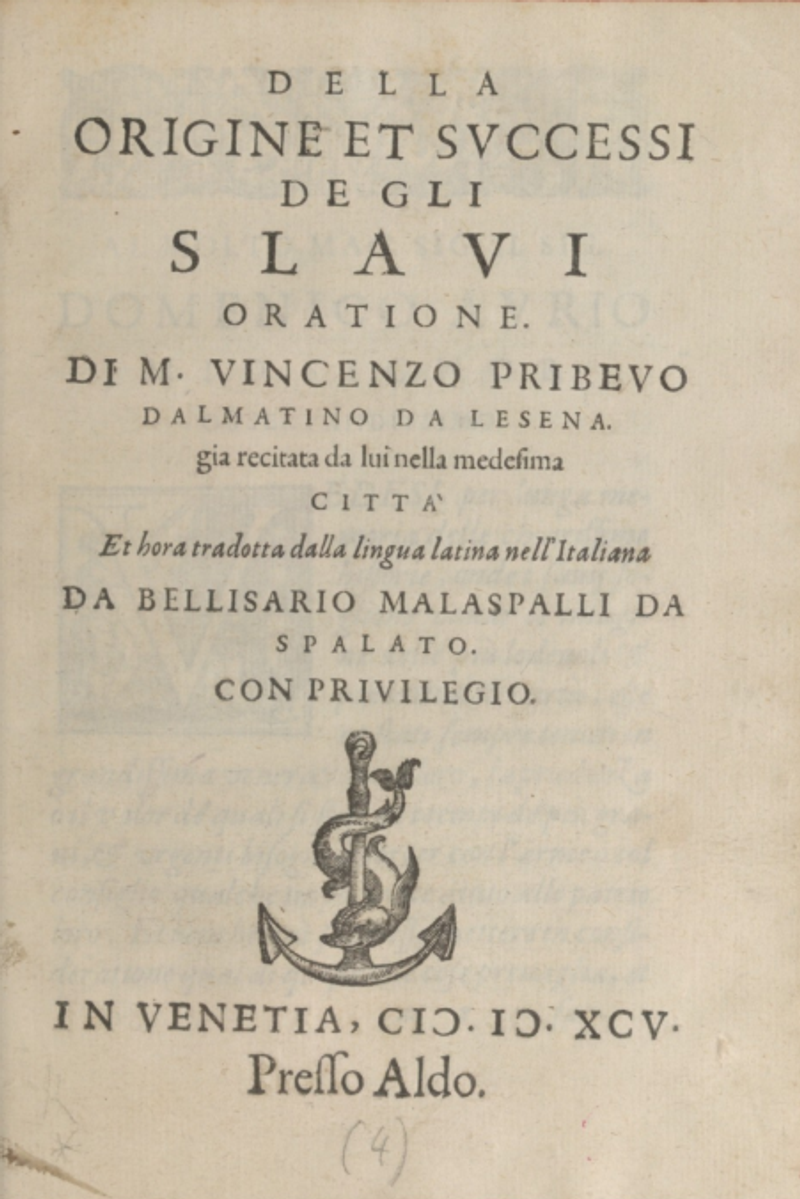
1595
Italian
On the Origin and Glory of the Slavs (1595)


Access Book
Description
This 1595 Italian edition, published decades after the original 1532 Latin oration, presents Vinko Pribojević’s celebration of Slavic heritage in a more accessible and narrative-driven style. While preserving the central thesis, that the Slavs are an ancient, noble, and heroic people, the translation shifts away from dense humanist rhetoric toward vivid storytelling. It still asserts that the Illyrians, Thracians, and Macedonians were Slavs and continues to claim illustrious historical figures, such as Alexander the Great, Roman emperors, and Saint Jerome, as part of the Slavic lineage.
The work emphasizes martial valor, unity, and cultural achievements over strict genealogical arguments, aiming to inspire pride and admiration rather than to convince through scholarly proof. The Italian text celebrates Slavic military triumphs, virtues, and resilience, framing them as equal to the accomplishments of classical Greece and Rome. While the Latin version relied heavily on classical citations and elaborate oratory, the Italian focuses on a smoother narrative flow that could reach merchants, local nobility, and the broader literate public of the Adriatic.
Politically, the translation maintains a friendly tone toward Venetians and Italians, portraying the Slavs as worthy allies and contributors to Mediterranean civilization. However, it is more openly celebratory of Slavic deeds and identity, resonating with late 16th-century regional pride. Della origine successi de gli Slavi thus functions both as a cultural bridge and as an early piece of popular historical myth-making, carrying forward Pribojević’s vision of a united and glorious Slavic past into a new linguistic and social context.
About the Author
Author
Vinko Pribojević(1450 - 1532)