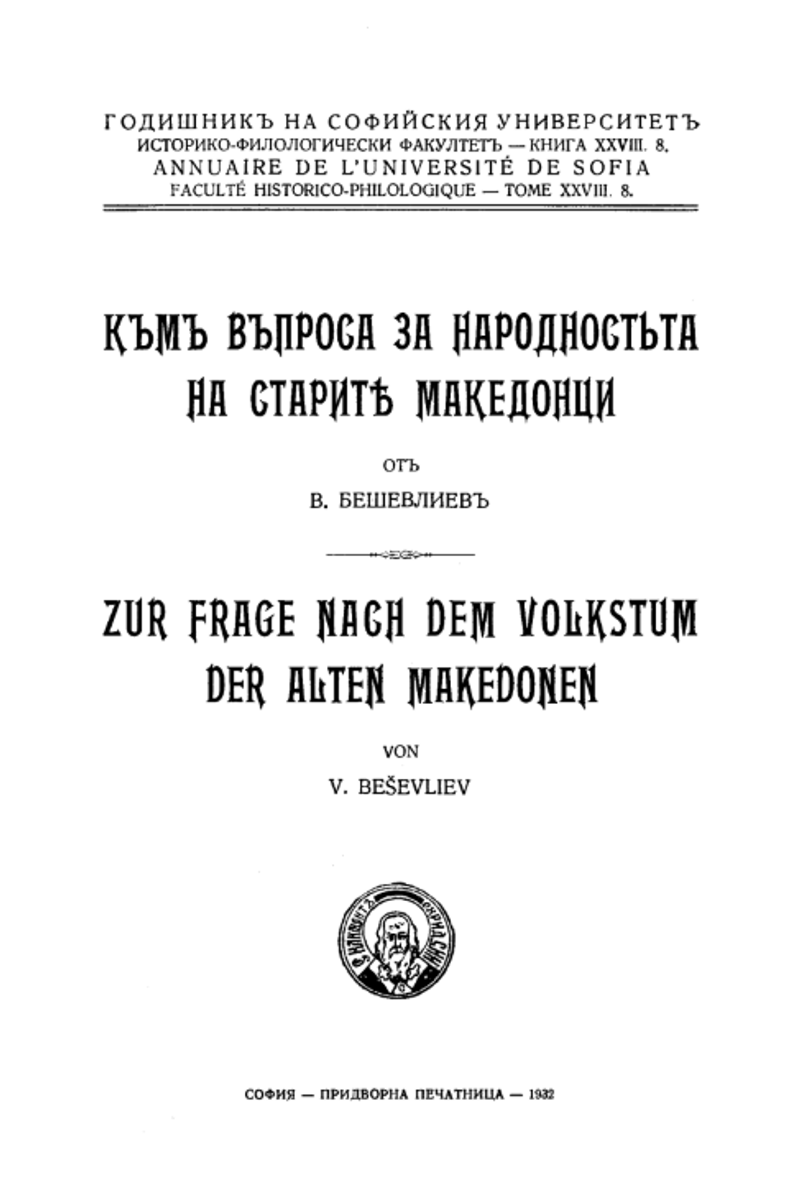
1932
Bulgarian
On the Question of the Nationality of the Ancient Macedonians
Access Book
Description
On the Question of the Nationality of the Ancient Macedonians by Veselin Beshevliev, published in 1932 in Sofia, delves into the contentious issue of the ethnic identity of the ancient Macedonians. The author, a prominent Bulgarian scholar specializing in ancient languages and epigraphy, sets out to challenge the dominant Hellenocentric narrative that portrays the Macedonians as an integral part of the Greek world. Drawing on a multidisciplinary approach, Beshevliev analyzes historical accounts from Greek and Roman sources, linguistic data, and archaeological findings to argue for a reevaluation of their origins.
In the core of his analysis, Beshevliev highlights linguistic differences between ancient Macedonian and Greek, pointing to unique vocabulary, phonetics, and onomastics that suggest closer affinities with Thracian or Illyrian languages rather than Hellenic dialects. He critiques ancient Greek historians like Herodotus and Thucydides for their biased depictions of Macedonians as "barbarians," attributing this to political rivalries. Through examinations of inscriptions, personal names, and cultural practices, the book posits that the Macedonians formed a distinct Indo-European ethnic group that gradually adopted Greek culture during the Hellenistic era.
Ultimately, Beshevliev concludes that the ancient Macedonians were not Greeks by origin but a separate people who played a pivotal role in spreading Hellenic civilization. This perspective aligns with interwar Balkan scholarly debates, emphasizing regional ethnic complexities. The work remains influential in discussions on Macedonian identity, though it reflects the nationalist sentiments of its time.
About the Author
Author
Veselin Beshevliev(1900 - 1992)