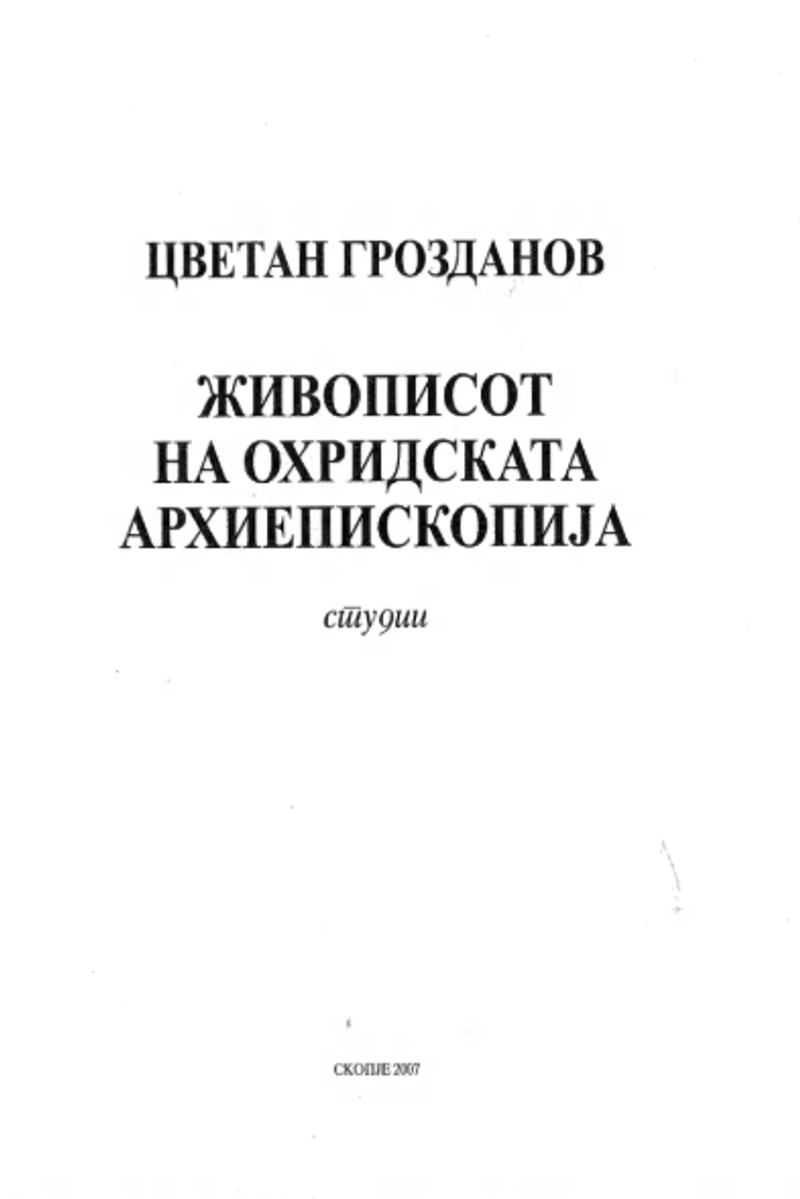
2007
Macedonian
Painting of the Ohrid Archbishopric
Access Book
Description
Painting of the Ohrid Archbishopric by Cvetan Grozdanov is a collection of 21 scholarly studies written over four decades, dedicated to the art and fresco painting of the Ohrid Archbishopric, one of the most significant ecclesiastical and cultural centers in the Balkans.
The work explores the role of Ohrid as a hub of Slavic literacy, theology, and art, tracing its heritage from the mission of Saints Cyril and Methodius and their disciples, St. Clement and St. Naum, through the Byzantine and Ottoman periods. Special focus is given to the Archbishopric’s frescoes, icons, miniatures, and illuminated manuscripts, many of which shaped the identity of Balkan Christian art.
Grozdanov analyzes important sites such as St. Sophia of Ohrid, St. Clement (St. Bogorodica Perivlepta), and Marko’s Monastery, presenting newly discovered portraits, iconographic programs, and stylistic evolutions from the 11th to the 19th centuries. The book also highlights the contributions of notable painters and workshops, including Michael and Eutychius, Jovan Zograf, and later masters like Dicho Zograf.
The author emphasizes how Ohrid’s artistic tradition combined Byzantine influences with local creativity, preserving a unique identity even after the abolition of the Archbishopric in 1767. He also shows how the memory of Ohrid’s saints and archbishops, St. Clement, St. Naum, St. Teophilactus, St. Constantine Cavassila—continued to inspire art, literature, and cultural revival during the Macedonian Renaissance of the 19th century.
Ultimately, the book underscores Ohrid’s role as a spiritual and artistic beacon, whose frescoes, icons, and manuscripts remain among the highest achievements of European medieval art.
About the Author
Author
Cvetan Grozdanov(1936 - 2018)