1899
English
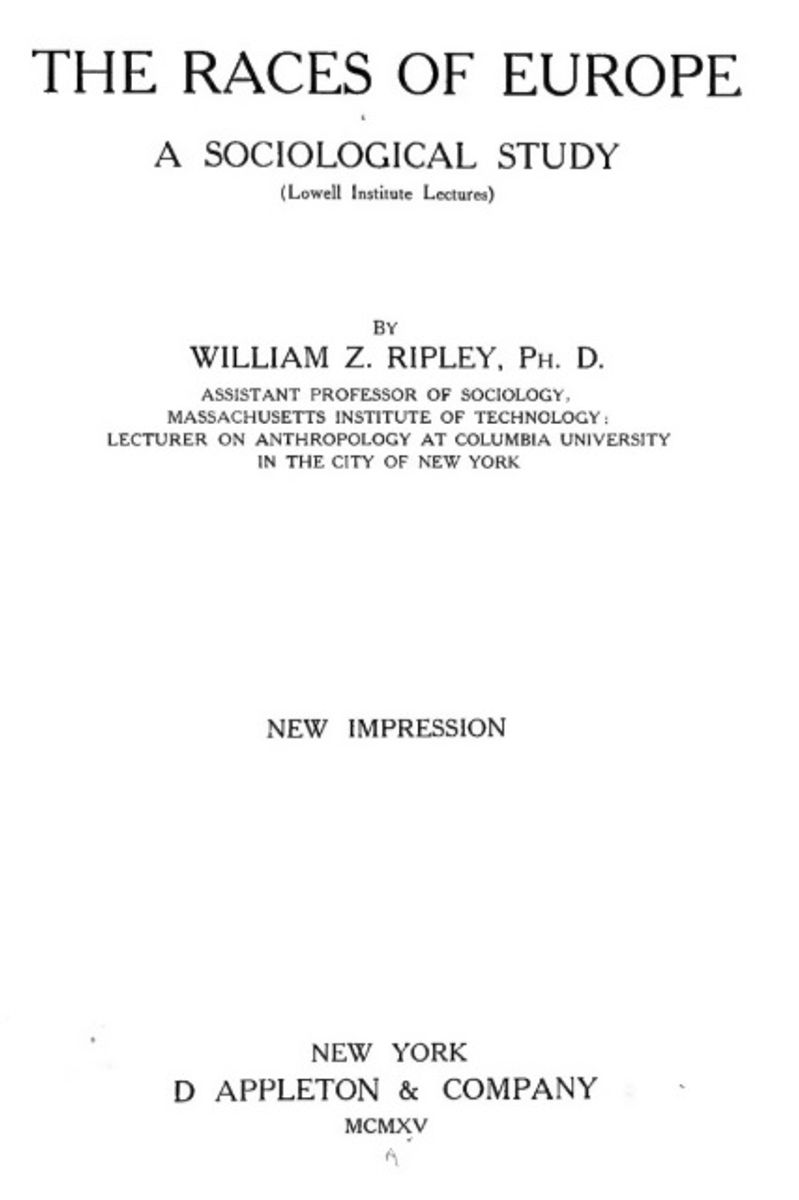
The Races of Europe: A Sociological Study
Access Book
Description
The Races of Europe: A Sociological Study by William Z. Ripley is a late nineteenth-century work that attempts to classify the populations of Europe through a combination of physical anthropology, geography, and social analysis. Drawing on measurements such as skull shape, stature, and pigmentation, Ripley organizes Europeans into three principal racial groups: the Teutonic, the Alpine, and the Mediterranean. The book reflects the dominant scientific thinking of its time, when racial classification was widely believed to be a legitimate tool for understanding human societies.
Ripley argues that geography and environment play a decisive role in shaping physical and social characteristics, and he places strong emphasis on the influence of climate, terrain, and historical migration. While he recognizes cultural and linguistic diversity, he treats race as a foundational explanatory category, linking physical traits to social organization, economic behavior, and historical development. His approach seeks to synthesize biological data with sociological interpretation, presenting race as a long-term structuring force in European history.
Today, The Races of Europe is regarded primarily as a historical document that illustrates the development of racial thought in Western scholarship rather than as a valid scientific framework. Modern anthropology and sociology reject its racial classifications as scientifically flawed and methodologically biased. Nevertheless, the book remains significant for understanding how concepts of race were constructed, normalized, and used to interpret European societies at the turn of the twentieth century.
About the Author
Author