1948
Macedonian
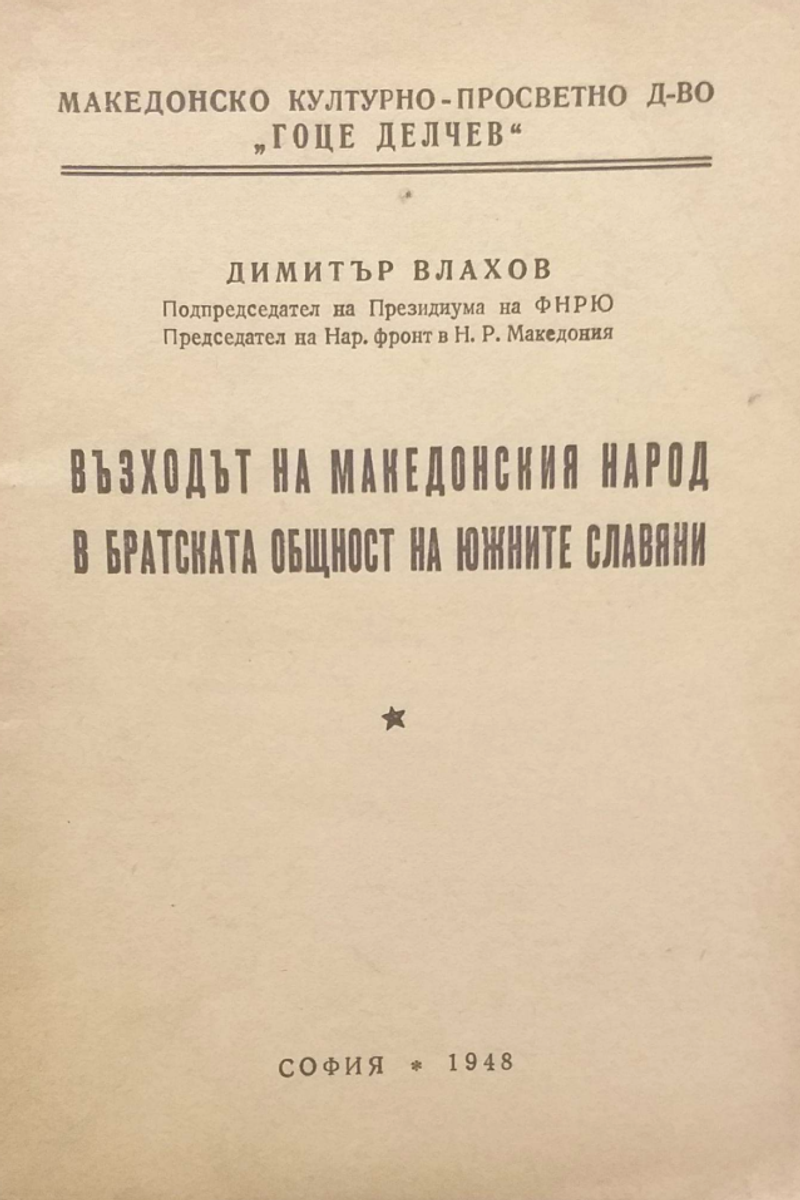
The Rise of the Macedonian People in the Brotherly Community of the South Slavs
by Macedonian Cultural and Educational Society "Goce Delchev"
Access Book
Description
The Rise of the Macedonian People in the Brotherly Community of the South Slavs by Dimitar Vlahov, published in Sofia in 1948, presents a political address delivered before Macedonian cultural organizations in Bulgaria. The text traces the historical struggle of the Macedonian people against Ottoman rule, through the Ilinden period and the Balkan Wars, to the anti-fascist resistance during the Second World War. Vlahov frames this development as a gradual national awakening culminating in the establishment of the People’s Republic of Macedonia within federal Yugoslavia.
A central theme of the work is the affirmation of a distinct Macedonian national identity and its institutional consolidation through the Anti-Fascist Assembly for the National Liberation of Macedonia (ASNOM). The author emphasizes the role of the partisan movement and the Yugoslav federal structure in enabling political equality and cultural development. Particular attention is given to education, language codification, representative institutions, and the integration of Macedonia into the broader South Slavic socialist community.
The publication reflects the political and ideological context of 1948 and articulates Macedonian statehood within the framework of Yugoslav federal socialism. Written at a moment of emerging tension between Yugoslavia and the Soviet bloc, it illustrates how Macedonian national development was presented in official discourse during the immediate post-war period. As a contemporary political speech, it serves as a primary source for understanding the intersection of national identity, socialist federalism, and regional realignments in the early Cold War Balkans.
About the Institution
Institution
The Macedonian Cultural and Educational Society "Goce Delchev" was a Macedonian émigré organization founded in Sofia after World War II by members of the Macedonian community in Bulgaria. Its primary goal was to promote Macedonian national identity, language, culture, and history among the Macedonian population in Pirin Macedonia and the wider diaspora. The society organized cultural events, lectures, publications, and educational initiatives dedicated to the preservation and affirmation of Macedonian heritage, often emphasizing the legacy of the revolutionary Goce Delchev as a symbol of the Macedonian liberation struggle.
Through its activities, the society became an important platform for affirming the distinct Macedonian national consciousness during a time when Macedonian identity was contested in Bulgaria. It also maintained connections with cultural and political institutions in the Socialist Republic of Macedonia, contributing to the strengthening of Macedonian cultural ties across borders.
Although later constrained by political shifts in Bulgaria, particularly after the 1948 Cominform Resolution and the reversal of policies towards Pirin Macedonia, the society left a lasting impact as a center of Macedonian cultural and educational activism.