1925
Bulgarian
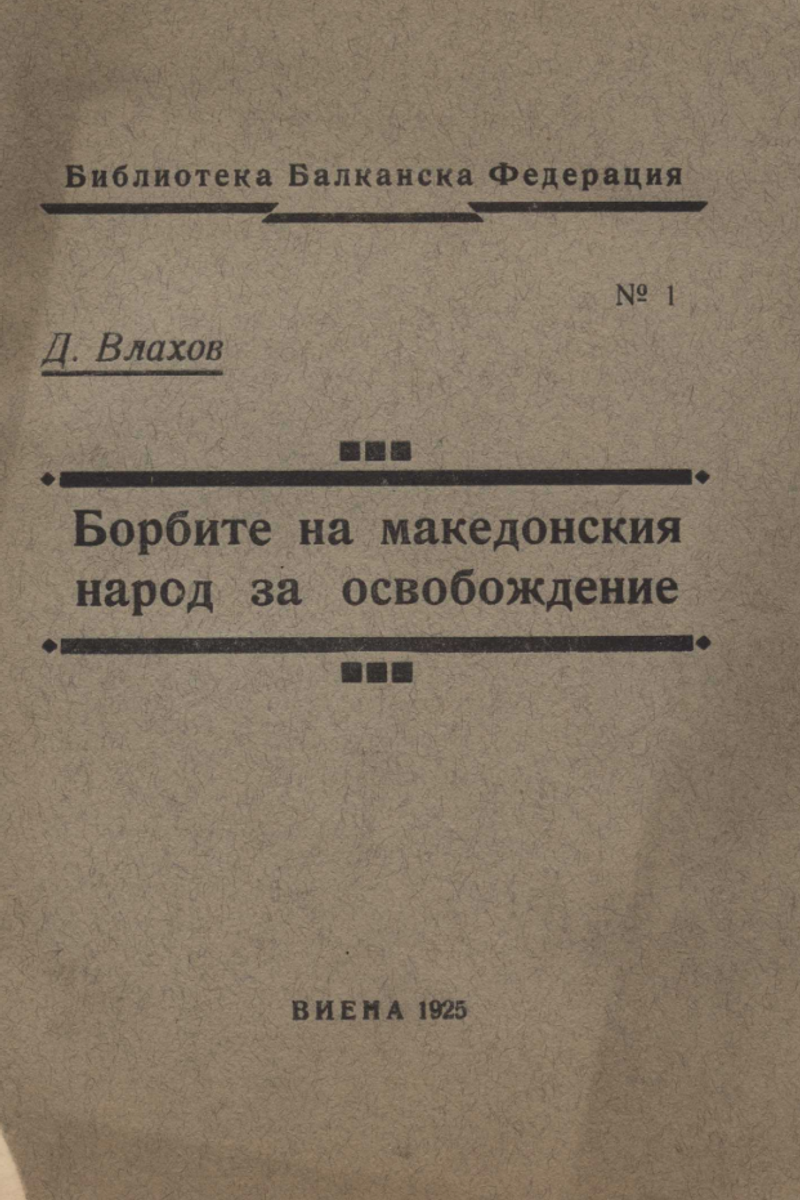
The Struggles of the Macedonian People for Liberation


Access Book
Description
The Struggles of the Macedonian People for Liberation by Dimitar Vlahov, published in Vienna in 1925 as part of the “Balkan Federation” series, presents a political-historical overview of the Macedonian liberation movement from the late Ottoman period to the aftermath of the Balkan Wars and the First World War. The opening chapters describe Macedonia’s geographic unity, economic exploitation under Ottoman rule, and the social structure of its population. Vlahov emphasizes the development of revolutionary consciousness among the Macedonian people as a response to political oppression and agrarian hardship.
A central part of the booklet examines the formation and activity of the Internal Revolutionary Organization, the preparation and course of the Ilinden Uprising, and the heavy human and material losses that followed (pp. 16–19). Vlahov presents the uprising as a mass national movement rather than an isolated insurrection, highlighting the participation of peasants, workers, and intellectuals. Subsequent chapters analyze the impact of the Balkan Wars (1912–1913), the partition of Macedonia among neighboring states, and the consequences of war, repression, and population displacement. The narrative stresses the continuity of the Macedonian struggle despite territorial division.
The publication reflects the political debates of the mid-1920s concerning the Macedonian question and the idea of a Balkan federation. Written in exile and addressed to an international audience, it integrates historical narrative with political argumentation about self-determination and regional restructuring. As a contemporary political study, the booklet serves as a primary source for understanding interwar interpretations of the Macedonian revolutionary movement and its place within broader discussions about national rights and federal solutions in Southeast Europe.
About the Author
Author
Dimitar Vlahov(1878 - 1953)