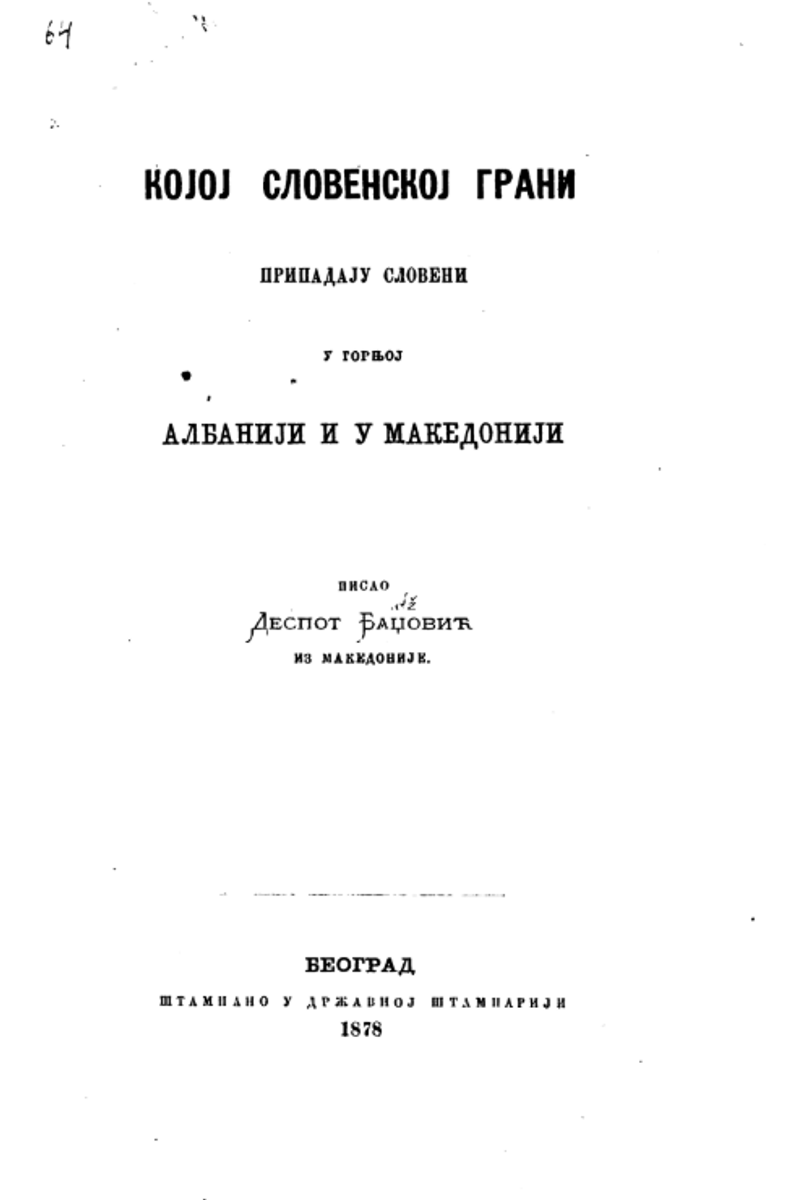
1878
Serbian
To Which Slavic Branch do the Slavs in Upper Albania and Macedonia Belong
More by Despot Badžović

Access Book
Description
"To which Slavic Branch do the Slavs in Upper Albania and Macedonia Belong", written by Despot Bađović from Macedonia in 1878, is an ethnographic and linguistic study that sought to prove the Slavic population of Macedonia was not Bulgarian, but rather a people most closely related to Serbs. Bađović argues that a people's national identity should be determined by their language, customs, and history, and his analysis centers on these points.
The core of Bađović's argument rests on linguistic and cultural comparisons. Linguistically, he asserts that the Macedonian dialect shares key phonetic and grammatical features with Serbian, such as the sounds ћ, ђ, and џ, which he claims are absent in Bulgarian. Culturally, he points to the celebration of the slava, or family patron saint's day, as a unique Serbian tradition also widely practiced by the Macedonians. He presents this, along with other shared customs, as a definitive link between the two peoples.
In conclusion, Bađović’s book argues against the prevailing narrative of his time that the Macedonian Slavs were Bulgarian. He presents linguistic evidence and cultural traditions, such as the slava and various holiday rituals, to assert that the Macedonians are a distinct Slavic group, but one that belongs to the Serbian branch of the Slavic family.
About the Author
Author
Despot Badžović(1850 - 1932)