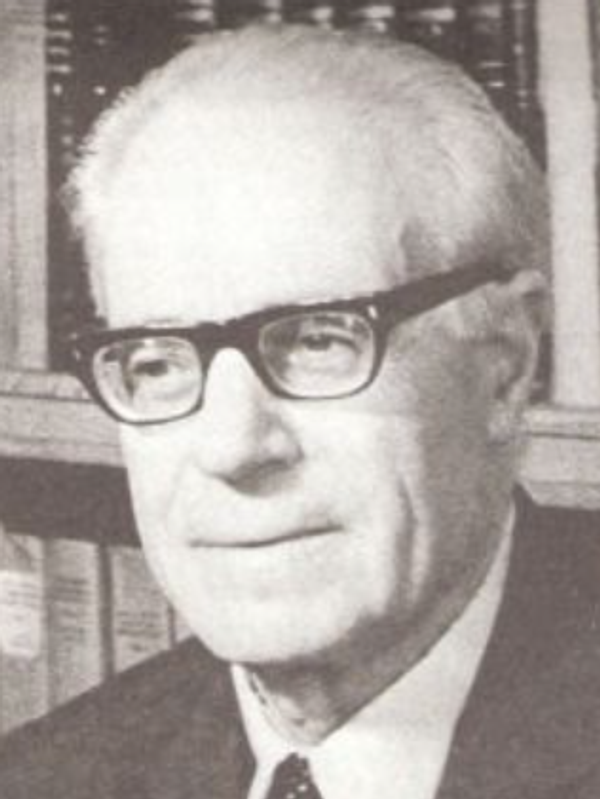
Ruben Avramov Levi
1900 - 1988
About the Author
Ruben Avramov Levi was a Bulgarian communist politician, historian, and cultural figure.
Born into a Jewish family in Samokov, he completed secondary school in his hometown. In 1919 he joined the Bulgarian Communist Youth Union, later becoming secretary of its Sofia organization, and from 1923 a member of its Central Committee, participating in preparations for the September Uprising. He became a member of the Bulgarian Communist Party in 1922.
In 1925 he was sentenced to death in absentia while attending a Comintern youth conference in the Soviet Union, where he remained and joined the All-Union Communist Party (Bolsheviks). He graduated from the International Lenin School in Moscow (1928) and subsequently taught at the Communist University of the National Minorities of the West (1928–1931) and at the International Lenin School (1931–1936).
During the Spanish Civil War, he served as divisional political commissar, coordinated the activities of communist military commissars across Spain, and joined the Communist Party of Spain. Following the Republican defeat in 1939, he returned to the Soviet Union, where he directed a two-year party school and later the United International School of the Comintern (1942). During World War II he also worked as an editor at the Bulgarian-language Soviet radio station.
After the war, Levi held prominent positions in Bulgaria’s communist leadership. He headed the propaganda department of the Central Committee of the Bulgarian Communist Party (1944–1947, 1949–1950) and briefly served as secretary of the Central Committee (June–November 1950). From 1952 to 1957 he was Minister of Culture. He later directed the Institute of History of the Bulgarian Communist Party (1962–1968) and the Institute of Contemporary Social Theories (1969–1981).
He was awarded the title Hero of Socialist Labour (1964) and Hero of the People’s Republic of Bulgaria (1980).
