1946
Bulgarian
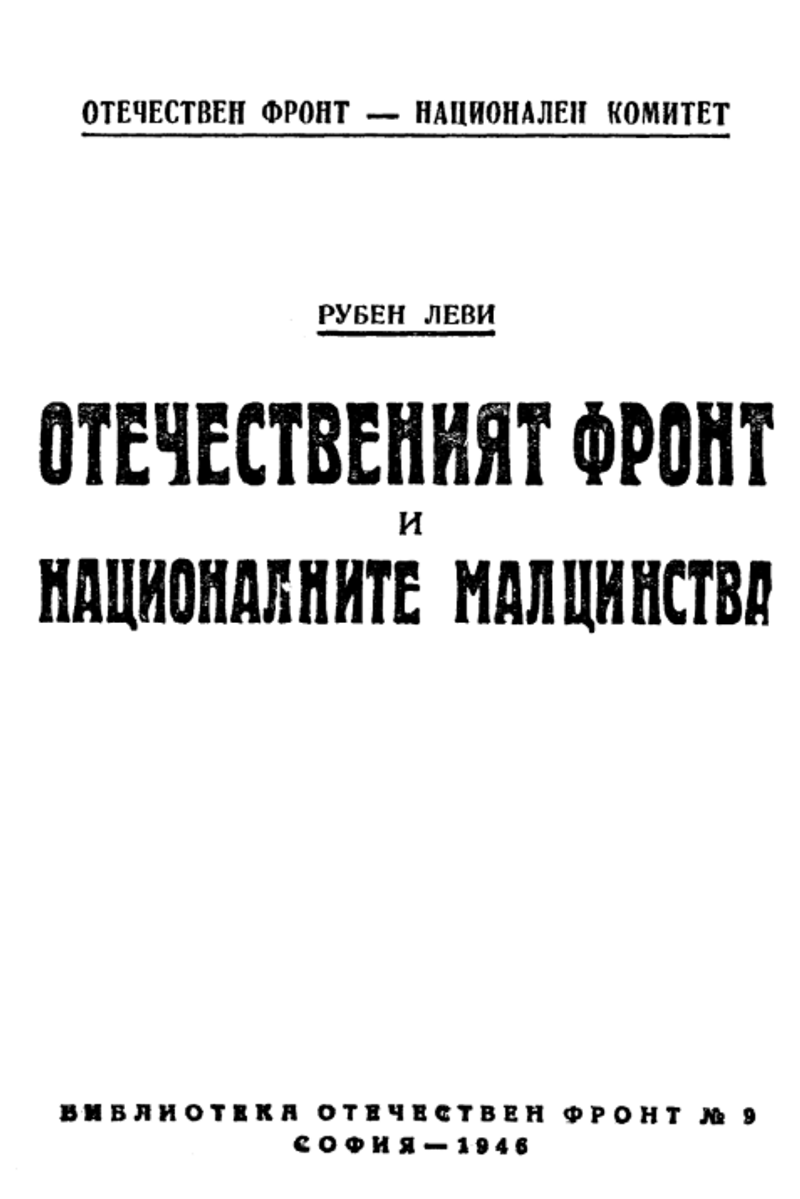
The Fatherland Front and the National Minorities
Access Book
Description
The Fatherland Front and the National Minorities by Ruben Levi, published in Sofia in 1946, presents the policy of the Fatherland Front toward the national minorities in post-war Bulgaria. The book describes the period before 9 September as one marked by repression, chauvinism, and systematic discrimination against Macedonians, Turks, Jews, Armenians, and other communities. It argues that fascist and monarchist regimes imposed heavy political, cultural, and economic pressure, particularly during the Second World War.
A significant portion of the work focuses on the Macedonian population in Pirin Macedonia, portraying it as subjected to both state repression and the actions of pro-Bulgarian nationalist groups. The text emphasizes the suppression of Macedonian cultural expression before 1944 and presents the post-September government as opening space for the free declaration of a distinct Macedonian identity and the development of a separate Macedonian culture. The narrative frames these changes as part of a broader democratic transformation.
The book concludes by presenting 9 September 1944 as a decisive turning point that introduced equality before the law and expanded rights for all minorities. It highlights constitutional guarantees, cultural rights, and educational reforms as evidence of a new political order. As a historical source, the work reflects the ideological framework of the early communist period and documents how minority policy, including the recognition of Macedonians in Pirin Macedonia, was officially articulated at that time.
About the Author
Author
Ruben Avramov Levi(1900 - 1988)
Ruben Avramov Levi was a Bulgarian communist politician, historian, and cultural figure.
Born into a Jewish family in Samokov, he completed secondary school in his hometown. In 1919 he joined the Bulgarian Communist Youth Union, later becoming secretary of its Sofia organization, and from 1923 a member of its Central Committee, participating in preparations for the September Uprising. He became a member of the Bulgarian Communist Party in 1922.
In 1925 he was sentenced to death in absentia while attending a Comintern youth conference in the Soviet Union, where he remained and joined the All-Union Communist Party (Bolsheviks). He graduated from the International Lenin School in Moscow (1928) and subsequently taught at the Communist University of the National Minorities of the West (1928–1931) and at the International Lenin School (1931–1936).
During the Spanish Civil War, he served as divisional political commissar, coordinated the activities of communist military commissars across Spain, and joined the Communist Party of Spain. Following the Republican defeat in 1939, he returned to the Soviet Union, where he directed a two-year party school and later the United International School of the Comintern (1942). During World War II he also worked as an editor at the Bulgarian-language Soviet radio station.
After the war, Levi held prominent positions in Bulgaria’s communist leadership. He headed the propaganda department of the Central Committee of the Bulgarian Communist Party (1944–1947, 1949–1950) and briefly served as secretary of the Central Committee (June–November 1950). From 1952 to 1957 he was Minister of Culture. He later directed the Institute of History of the Bulgarian Communist Party (1962–1968) and the Institute of Contemporary Social Theories (1969–1981).
He was awarded the title Hero of Socialist Labour (1964) and Hero of the People’s Republic of Bulgaria (1980).