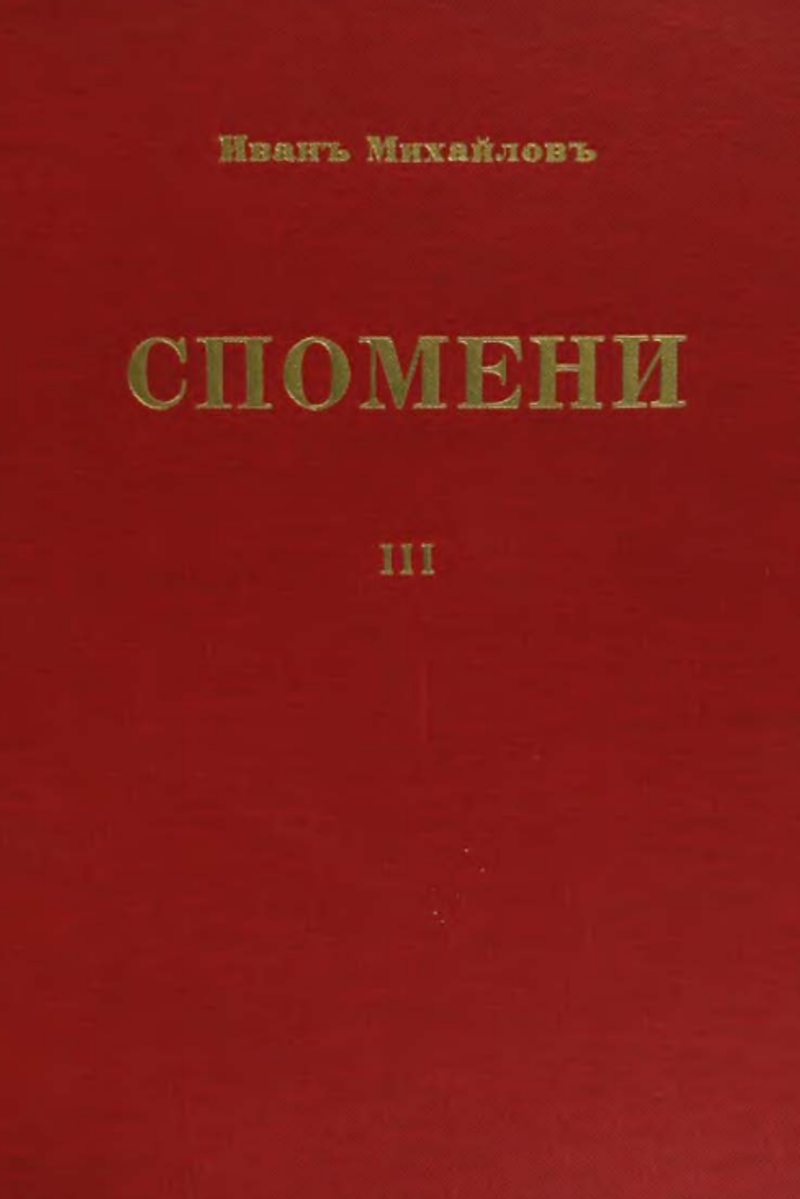
1967
Bulgarian
Memoirs, Vol. 3: Revolutionary Struggle 1924-1934
More by Ivan Mihailov
How Our National Awakeners and Heroes Wrote
1993
by Ivan Mihailov
The Macedonian Question and Yugoslavia
1990
by Ivan Mihailov
IMRO
1978
by Ivan Mihailov
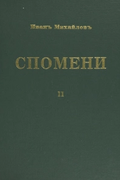
Memoirs, Vol. 2: Revolutionary Struggle 1919-1924
1965
by Ivan Mihailov
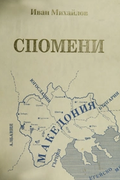
Memoirs, Vol. 1: Youth
1958
by Ivan Mihailov
Access Book
Description
Memoirs, Vol. 3: Revolutionary Struggle 1924-1934 by Ivan Mihailov, published in 1967 as part of his multi-volume recollections, covers the most turbulent decade of internal conflict, armed actions, and political realignment within the IMRO. The volume focuses on the period following the assassination of Todor Alexandrov in 1924 and presents Mihailov’s account of how the organization was preserved, reorganized, and redirected during a time of crisis. The narrative combines personal testimony with political justification, portraying IMRO as the central force defending the Macedonian cause against Serbian and Greek state policies.
A central thesis of the volume is the claim that the Slavic population of Macedonia formed part of the Bulgarian national body, and that the revolutionary struggle represented the continuation of Bulgarian national aspirations in Macedonia. Mihailov describes punitive actions against alleged collaborators, confrontations with Yugoslav authorities, and the broader campaign of armed resistance carried out during the late 1920s and early 1930s. The text presents these actions as necessary measures to prevent denationalization and political suppression.
Today, the publication is treated as a source representing a Bulgarian nationalist reading of the Macedonian revolutionary movement. As a memoir written decades after the events, it reflects Mihailov’s ideological convictions and his opposition to the recognition of a distinct Macedonian nation. At the same time, the volume remains a significant primary source for understanding internal divisions within IMRO, the escalation of revolutionary violence, and the broader geopolitical tensions surrounding the Macedonian question in the interwar period.
About the Author
Author
Ivan Mihailov(1896 - 1990)
Ivan Mihailov, also known as Vancho Mihailov or Radko, was a revolutionary and political leader of the Internal Macedonian Revolutionary Organization (IMRO). Born in Novo Selo, Štip, he studied in Štip, Thessaloniki, and Skopje before continuing law studies at Sofia University. In the early 1920s, he became secretary to Todor Alexandrov, later joining IMRO’s Central Committee after Alexandrov’s assassination.
Mihailov promoted the idea of an independent and united Macedonia, but within a framework tied closely to Bulgaria, regarding Pirin Macedonia as its core. As IMRO leader from 1925, he implemented a policy of individual terror, organizing political assassinations of rivals and establishing a semi-official parallel authority in Pirin Macedonia with Bulgarian state approval. He cultivated ties with Fascist Italy and later collaborated with Ante Pavelić’s regime in the Independent State of Croatia, as well as with Nazi Germany during World War II.
After the 1934 coup in Bulgaria and IMRO's ban, Mihailov lived in exile in Turkey, Poland, Croatia, Austria, Spain, and Italy. In September 1944, with German backing, he briefly attempted to form a puppet “Independent Macedonia” in Skopje, but failed to gain support.
Postwar, he resided in Rome, supported financially by the Macedonian Patriotic Organization in the U.S. and Canada. He authored multi-volume memoirs and other works. Remembered as a divisive figure, he is regarded in Bulgarian historiography as a national liberation activist, but in Macedonian and left-wing narratives as a terrorist, collaborator, and the most controversial leader of the IMRO.
More by Ivan Mihailov
How Our National Awakeners and Heroes Wrote
1993
by Ivan Mihailov
The Macedonian Question and Yugoslavia
1990
by Ivan Mihailov
IMRO
1978
by Ivan Mihailov
Memoirs, Vol. 2: Revolutionary Struggle 1919-1924
1965
by Ivan Mihailov
Memoirs, Vol. 1: Youth
1958
by Ivan Mihailov