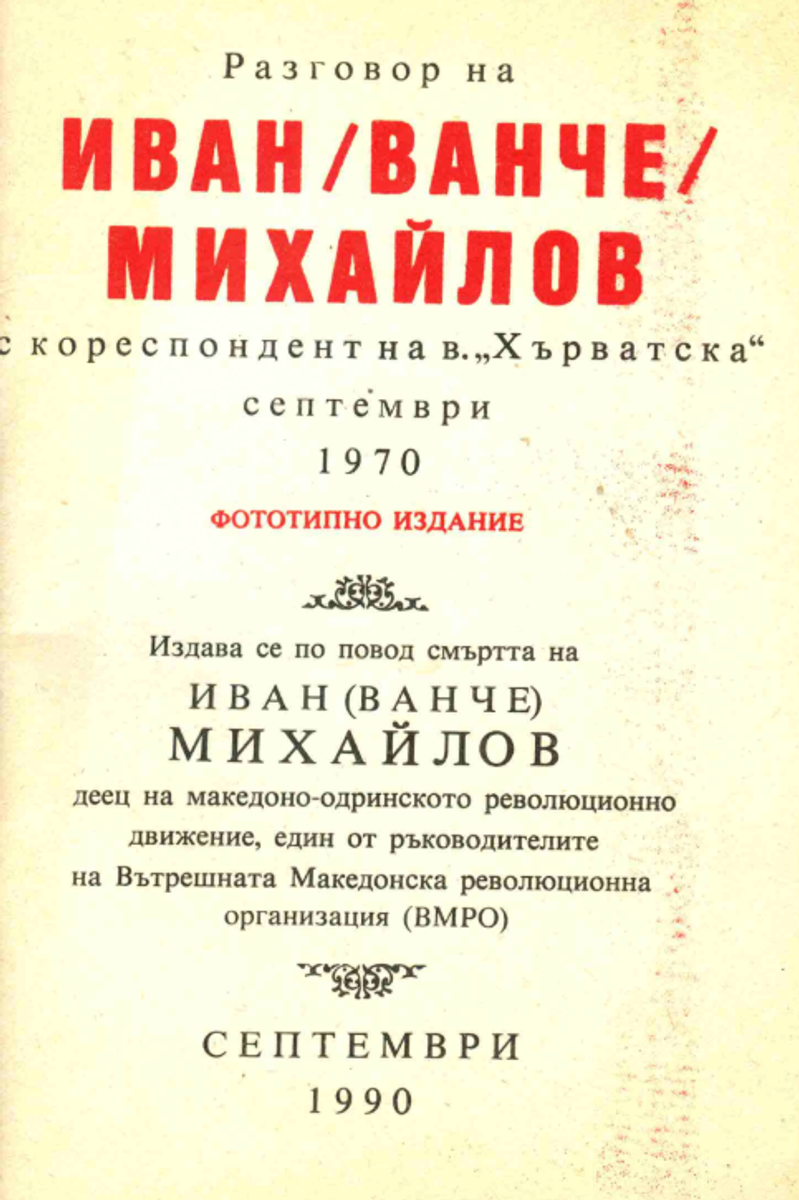
1990
Bulgarian
The Macedonian Question and Yugoslavia
More by Ivan Mihailov
How Our National Awakeners and Heroes Wrote
1993
by Ivan Mihailov
IMRO
1978
by Ivan Mihailov
Memoirs, Vol. 3: Revolutionary Struggle 1924-1934
1967
by Ivan Mihailov
Memoirs, Vol. 2: Revolutionary Struggle 1919-1924
1965
by Ivan Mihailov
Memoirs, Vol. 1: Youth
1958
by Ivan Mihailov
Access Book
Description
The Macedonian Question and Yugoslavia by Ivan (Vanche) Mihajlov, published in 1971 as a recorded conversation with a correspondent of the Croatian newspaper Hrvatska, presents Mihajlov’s interpretation of the political developments in Macedonia and the Balkans during the twentieth century. The work reflects his long-standing position as a leading figure of the right-wing faction of VMRO and offers a critique of Yugoslav state policy toward Macedonia. Throughout the interview, Mihajlov challenges the legitimacy of the Macedonian nation as recognized within socialist Yugoslavia.
A central argument of the text is that the population of Macedonia historically constituted part of the Bulgarian national body, and that the concept of a separate Macedonian identity was constructed under Yugoslav communist rule. Mihajlov repeatedly asserts that the revolutionary movement in Macedonia was founded by and composed of what he calls Macedonian Bulgarians, presenting linguistic and historical arguments in support of this claim. The discussion also extends to the policies of the Serbian monarchy, the communist authorities after 1944, and what he characterizes as systematic reinterpretation of historical memory.
Today, the booklet is understood primarily as a document of Bulgarian nationalist historiography and émigré political thought during the Cold War period. Rather than a neutral historical study, it reflects Mihajlov’s ideological convictions and his opposition to Yugoslav federalism and socialist national policy. As such, the text remains significant for examining competing interpretations of identity, revolutionary heritage, and statehood in the history of Macedonia.
About the Author
Author
Ivan Mihailov(1896 - 1990)
Ivan Mihailov, also known as Vancho Mihailov or Radko, was a revolutionary and political leader of the Internal Macedonian Revolutionary Organization (IMRO). Born in Novo Selo, Štip, he studied in Štip, Thessaloniki, and Skopje before continuing law studies at Sofia University. In the early 1920s, he became secretary to Todor Alexandrov, later joining IMRO’s Central Committee after Alexandrov’s assassination.
Mihailov promoted the idea of an independent and united Macedonia, but within a framework tied closely to Bulgaria, regarding Pirin Macedonia as its core. As IMRO leader from 1925, he implemented a policy of individual terror, organizing political assassinations of rivals and establishing a semi-official parallel authority in Pirin Macedonia with Bulgarian state approval. He cultivated ties with Fascist Italy and later collaborated with Ante Pavelić’s regime in the Independent State of Croatia, as well as with Nazi Germany during World War II.
After the 1934 coup in Bulgaria and IMRO's ban, Mihailov lived in exile in Turkey, Poland, Croatia, Austria, Spain, and Italy. In September 1944, with German backing, he briefly attempted to form a puppet “Independent Macedonia” in Skopje, but failed to gain support.
Postwar, he resided in Rome, supported financially by the Macedonian Patriotic Organization in the U.S. and Canada. He authored multi-volume memoirs and other works. Remembered as a divisive figure, he is regarded in Bulgarian historiography as a national liberation activist, but in Macedonian and left-wing narratives as a terrorist, collaborator, and the most controversial leader of the IMRO.
More by Ivan Mihailov
How Our National Awakeners and Heroes Wrote
1993
by Ivan Mihailov
IMRO
1978
by Ivan Mihailov
Memoirs, Vol. 3: Revolutionary Struggle 1924-1934
1967
by Ivan Mihailov
Memoirs, Vol. 2: Revolutionary Struggle 1919-1924
1965
by Ivan Mihailov
Memoirs, Vol. 1: Youth
1958
by Ivan Mihailov