2006
Macedonian
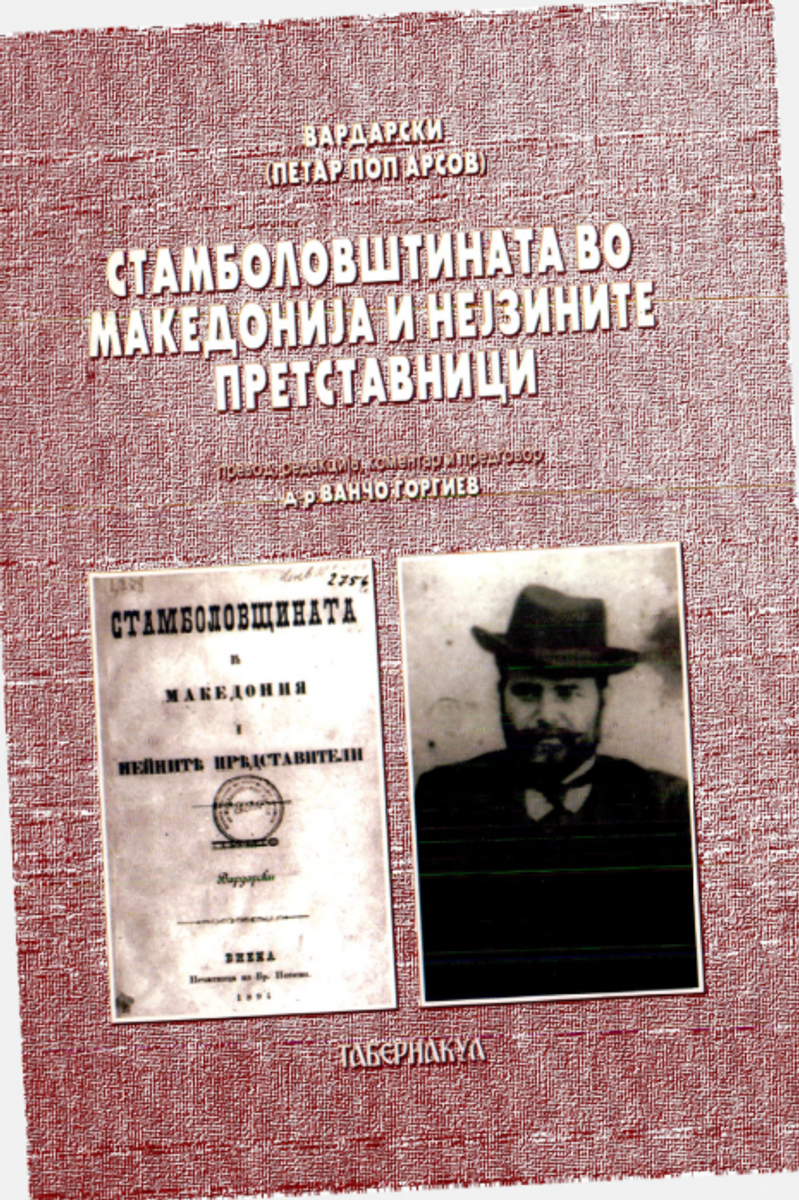
Stambolovism in Macedonia and Its Representatives (2006)
More by Petar Pop Arsov

Access Book
Description
This book is reesued in 2006, in Macedonian, while the original was published in 1894 in Sofia, by Petar Pop Arsov under the pseudonym Vardarski, by directive of the Central Committee of the Macedonian Revolutionary Organization (MRO). Although printed in Bulgarian, it was aimed not only at Macedonians but also at the emigrated community and sympathetic Bulgarians.
Its purpose was to expose and criticize the policies of the Bulgarian Prime Minister Stefan Stambolov and the Bulgarian Exarchate's church-educational propaganda in Macedonia. The brochure called on “all honest Macedonians” to resist these influences and protect local autonomy and cultural institutions such as municipalities and schools, presenting them as vital to preserving Macedonian identity.
Following its release, the brochure triggered strong reactions in Bulgaria, where critics accused the authors of betrayal and condemned the text in outlets like “Bulgarian Review” in 1895.
Petar Pop Arsov, one of the early leaders of the Macedonian revolutionary movement, expressed his frustration with Bulgarian influence in Macedonia. In his words:
“The Exarchate gives money and buys only wind, because nationality cannot be bought with money – it is such a delicate thing that, the moment it senses you are trying to trade it, it evaporates... Recently, suspecting some kind of separatism, it is clear that (it strives) above all to undermine our nationality. It seeks to kill every independent movement among us, to take away every possibility for Macedonians to concern themselves with higher social questions, and in that way... to place the Macedonian national spirit in complete dependence on it, to fence it in like a bird in a cage... not chaining us to drag us about like a dancing bear, leading us wherever it gets the biggest reward... They give us money in order to kill us. To hell with that money, if by destroying our municipalities they still impose on us all sorts of presidents, bishops, directors, teachers, and the like, only to control the sums – the sole motive of Bulgarian propaganda... Yes, Bulgarian propaganda!”
About the Author
Author
Petar Pop Arsov(1868 - 1941)
Petar Pop Arsov was one of those quiet yet foundational figures upon whom Macedonian revolutionary thought and the struggle for freedom were built.
Born in the Macedonian village of Bogomila, near Veles, he felt the weight of injustice and enslavement from an early age. As a student he was expelled from the Thessaloniki Exarchate Gymnasium – an act that did not break him, but strengthened his spirit.
His path led him to Belgrade, yet his love for Macedonia, as with his comrade Dame Gruev, brought him back. He furthered his education in Sofia, where he graduated in philology, so that he could serve his homeland with word, thought, and pen.
In 1893, as a professor in Thessaloniki, Petar Pop Arsov became part of a historic moment – the creation of the Macedonian Revolutionary Organization. He was among its first leaders, a member of the first Central Committee, and the man entrusted with writing the first Constitution of the Organization. With that act he embedded his thought into the foundations of the Macedonian struggle for freedom and independence.
The price for that struggle was high. During the Vinica Affair he was arrested and sent into harsh five-year exile in Bodrum-Kale, Asia Minor. But neither chains nor distance broke his faith in Macedonia. After the Ilinden Uprising, despite painful divisions, he remained loyal to the idea of a people’s, just, and free homeland.
At the Rila Congress of 1905 he was elected as one of the three foreign representatives of VMORO – testimony to the trust and respect he enjoyed among his comrades. During the years of the Young Turk (Hurriyet) period he lived and worked in Skopje, continuing to serve with knowledge, morality, and self-sacrifice.
After the First World War life took him to Bulgaria, where he worked modestly as a teacher in the village of Kostenets, yet he never ceased to write and to fight with the pen for the Macedonian truth.
Petar Pop Arsov passed away on January 1, 1941, in Sofia.
He departed quietly, far from his native land, but his work remained deeply engraved in history. He stands as proof that freedom is built not only with the rifle, but also with mind, honor, and unwavering love for Macedonia.