1894
Bulgarian
Stambolovism in Macedonia and Its Representatives (1894)
More by Petar Pop Arsov

Access Book
Description
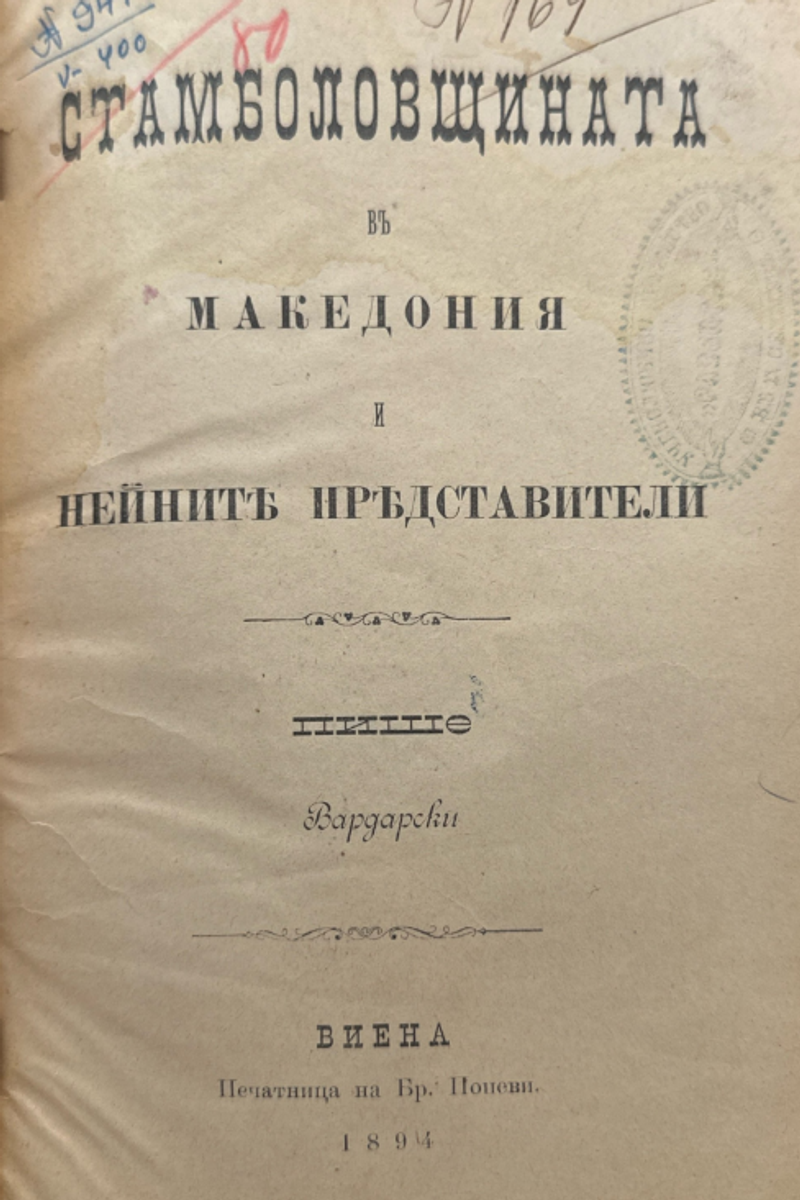
“Stambolovism in Macedonia and Its Representatives” is a brochure written at the request of the Central Committee of the MRO. The decision for its creation was made during the January meeting, and the Macedonian national-liberation activist Petar Poparsov was entrusted with preparing it.
The brochure was printed in Sofia by Ivan Hadzhi Nikolov. Because there was danger to the lives of its authors, P. Pop Arsov signed it under the pseudonym Vardarski, and Vienna was indicated as the place of printing. The brochure was written in the Bulgarian language; however, it was not intended only for Macedonians, but also for the Macedonian эмиграција and for Bulgarians in Bulgaria. Its task was to expose the policy of the Bulgarian Prime Minister Stefan Stambolov and the church-educational propaganda of the Bulgarian Exarchate in Macedonia.
The brochure received its name from Prime Minister Stefan Stambolov. It was written at the request of the Central Committee of MRO. Since the brochure was created by order of the Central Committee of the Macedonian Revolutionary Organization, and its author was one of the founders of that organization, from it we learn the position that the MRO took toward Bulgarian propaganda, and we also see the struggle that the organization began against such activity. In the Republic of Macedonia, one of the first analyses of the book was given by Petar Stojanov in 1963.
About Stefan Stambolov
Stambolov had imagined that he was truly called by Providence to play the role of a Bulgarian Bismarck… And not only will we not applaud him, but we condemn him, and together with us the entire Bulgarian people should condemn him, especially the Macedonian Bulgarians, because even into this Bulgarian ideal Stambolov mixed his egoism and madness… That tyrant, who left nothing sacred and pure for the Bulgarian, in order to satisfy his lust for power wished to make use of the educational cause in Macedonia. That debaucher, who toyed with the honor, life, and property of his compatriots in the Principality, wished to do the same with us Macedonians, in our own homeland Macedonia.
On the Educational Cause in Macedonia
The Macedonians, who could not endure:
how the fate of their homeland was being mocked… openly said that the educational work in Macedonia was being pushed toward ruin.
They emphasized that it was necessary to work:
so that the municipalities gradually support the schools themselves and that preference be given to the local intelligentsia, from whose midst teachers, directors, archimandrites, and bishops should be chosen… that the schools, in a word, as they are now organized, do not take into account the interests of the land for which they supposedly exist.
We do not have a school department in Constantinople that would care for the proper development of the educational work in Macedonia, but instead we have simply and purely a northern-Bulgarian Jesuit detachment with a known task… a task that also contains the tendency – to create Bulgarians in Macedonia!
On the Bulgarian Teachers
The citizens have already begun to make fun of the former minister; it is hard for Bay Sarafov when a man suddenly falls morally in the eyes of the people – isn’t it?… and we assure you that the position of all your compatriots who come to Macedonia with the pretension to create Bulgarians, to “cultivate” the land, will continue in the same way… even more difficult will become the position of your leadership, whoever it may be, if you continue to give such instructions. The Bulgarian idea will not prosper if you proceed with such a mindset. For we Macedonians have gained absolutely nothing thanks to blind trust in our so-called brothers, so we have nothing to lose.
The teaching staff at the Thessaloniki Exarchate Gymnasium was divided into three groups:
privileged northerners, “prudent unreliable ones,” and separatists.
(The first ones) as pioneers of the Bulgarian idea… led in Thessaloniki by Sarafov… are masters of the Thessaloniki Gymnasium and are free every day to throw some insult… We feed you – feed a dog so it can bark at you.
On the Exarchate
The Exarchate gives money and buys wind, because nationality cannot be bought with money – it is such a delicate thing that as soon as it senses it is being traded, it evaporates.
Suspecting lately some kind of separatism, and at first – seeing it in our nationality – it strives to kill every independent movement among us, to take away every possibility for Macedonians to deal with higher social questions, and in that way… to place the Macedonian national spirit in full dependence on it, to cage it like a bird… to chain us so as to make us dance like a bear, and to lead us wherever it receives a large tip.
Through the brochure, the Macedonian Revolutionary Organization calls:
for help from all honest Macedonians! Come to save the municipalities… (because they are) our only parliament, where the old democratic Slavic spirit of our people was strengthened and preserved… the only national institution that preserved our nationality and human physiognomy during the five-hundred-year period.
Immediately after the publication of the book, there were strong reactions against it in Bulgaria. Among the first to publicly criticize it was Dimitar Matov; later the book was analyzed in the journal “Bulgarian Review” in 1895. The authors were accused of being traitors to their nationality, degenerates of society, and that they had been bribed.
About the Author
Author
Petar Pop Arsov(1868 - 1941)
Petar Pop Arsov was one of those quiet yet foundational figures upon whom Macedonian revolutionary thought and the struggle for freedom were built.
Born in the Macedonian village of Bogomila, near Veles, he felt the weight of injustice and enslavement from an early age. As a student he was expelled from the Thessaloniki Exarchate Gymnasium – an act that did not break him, but strengthened his spirit.
His path led him to Belgrade, yet his love for Macedonia, as with his comrade Dame Gruev, brought him back. He furthered his education in Sofia, where he graduated in philology, so that he could serve his homeland with word, thought, and pen.
In 1893, as a professor in Thessaloniki, Petar Pop Arsov became part of a historic moment – the creation of the Macedonian Revolutionary Organization. He was among its first leaders, a member of the first Central Committee, and the man entrusted with writing the first Constitution of the Organization. With that act he embedded his thought into the foundations of the Macedonian struggle for freedom and independence.
The price for that struggle was high. During the Vinica Affair he was arrested and sent into harsh five-year exile in Bodrum-Kale, Asia Minor. But neither chains nor distance broke his faith in Macedonia. After the Ilinden Uprising, despite painful divisions, he remained loyal to the idea of a people’s, just, and free homeland.
At the Rila Congress of 1905 he was elected as one of the three foreign representatives of VMORO – testimony to the trust and respect he enjoyed among his comrades. During the years of the Young Turk (Hurriyet) period he lived and worked in Skopje, continuing to serve with knowledge, morality, and self-sacrifice.
After the First World War life took him to Bulgaria, where he worked modestly as a teacher in the village of Kostenets, yet he never ceased to write and to fight with the pen for the Macedonian truth.
Petar Pop Arsov passed away on January 1, 1941, in Sofia.
He departed quietly, far from his native land, but his work remained deeply engraved in history. He stands as proof that freedom is built not only with the rifle, but also with mind, honor, and unwavering love for Macedonia.