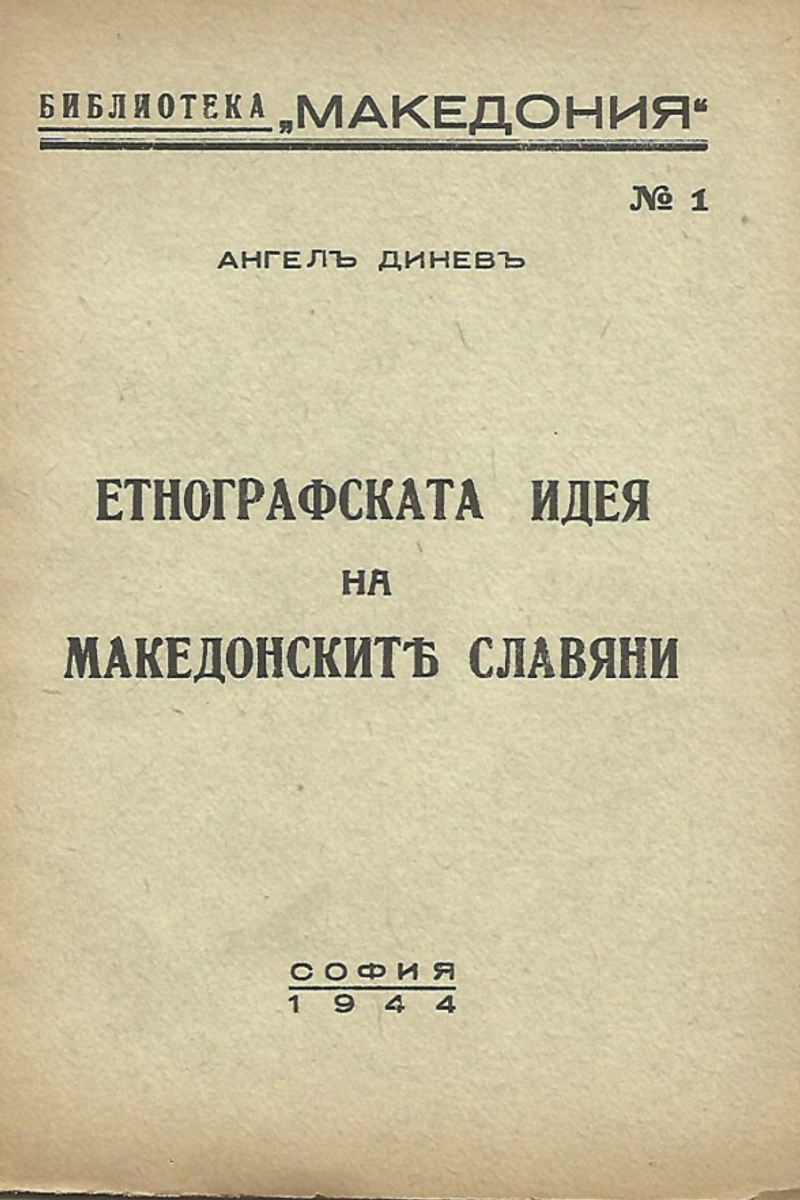
1944
Bulgarian
The Ethnographic Idea of the Macedonian Slavs
by Angel Dinev


Access Book
Description
The Ethnographic Idea of the Macedonian Slavs by Angel Dinev is the first book in the "Macedonia" library series. The book argues that the ethnographic idea of the Macedonian Slavs is the core of Macedonian nationalism and is a timely and unifying concept. The author believes that studying this idea is crucial for all southern Slavs to help Macedonia and end regional disputes.
The book chronicles the history of the Macedonian national awakening, starting with the struggle against the Patriarchate and later, the Exarchate. It recounts the work of figures like Bishop Theodosius of Skopje and Bishop Parteniy Zografski, who fought for an independent Macedonian church and education in the Macedonian native language. The author criticizes the "Mlada Makedonska knizhovna druzhina" (Young Macedonian Literary Society) and the revolutionary organization for making a "fatal mistake" by adopting Bulgarian script as a temporary measure to focus on political liberation. This decision, driven by economic hardships and the fear of fighting on two fronts, allowed a "false Macedonian public" to emerge in Bulgaria and led to the suppression of the Macedonian national idea.
The document further explains that this initial error continued to be a problem after the Ilinden Uprising, where debates over the location of the central committee and other issues took precedence over the ethnic question.
The author argues that the failure to prioritize ethnic consciousness was a major and fateful mistake that weakened the fight for a free and independent Macedonia and allowed external influences to more easily infiltrate the revolutionary organization.
About the Author
Author
Angel Dinev(1891 - 1952)
Angel Dinev was a Macedonian revolutionary, journalist, publicist, historian, and political activist. He was an active participant in the Macedonian revolutionary movement and a prominent figure associated with IMRO (United). Through his political engagement and intellectual work, Dinev consistently advocated for the recognition of the Macedonian people as a distinct national community.
In his early years, Dinev worked as a bakery laborer in Thessaloniki (1909–1911), during which time he became an organizer of the Provisional District Committee of IMRO for villages in the eastern part of the Gevgelija region. He later relocated to Sofia in 1922, where he became deeply involved in Macedonian émigré circles. He contributed editorials to the newspaper Ilinden and served for two decades as head of the Gevgelija Brotherhood. As owner and editor of Macedonian News (1935–1936), he played a significant role in articulating and affirming Macedonian national thought.
Following Bulgaria’s capitulation in September 1944, Dinev was among the signatories of the Appeal to the Macedonians in Bulgaria, alongside other notable revolutionary figures. He later edited the newspaper Dobrovolets and continued his political and scholarly work. In his major writings—The Macedonian Slavs, The Ilinden Epic, and Political Murders in Bulgaria—he explicitly asserted the historical and national existence of the Macedonian people. His legacy endures through his remembered contributions to Macedonian historiography, journalism, and national liberation thought.