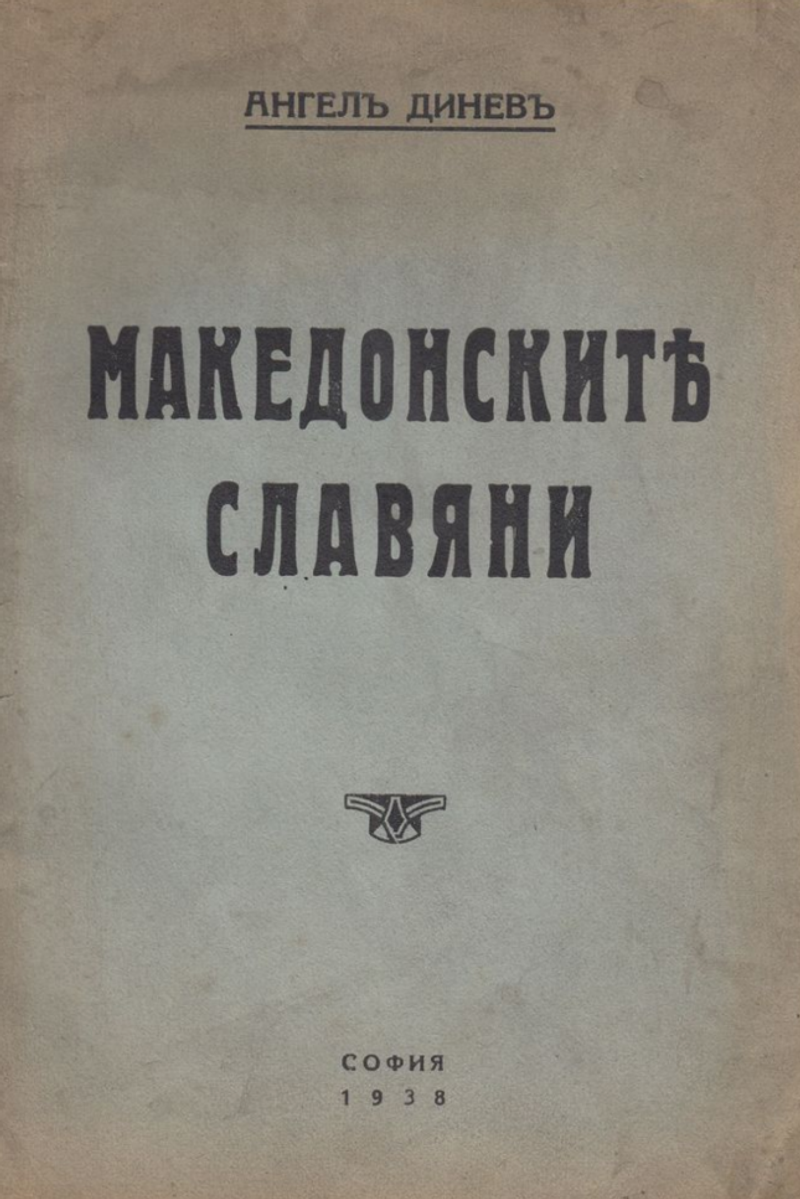
1938
Bulgarian
The Macedonian Slavs
by Angel Dinev


Access Book
Description
The book The Macedonian Slavs by Angel Dinev examines the historical and cultural development of the Slavic population in Macedonia.
The work begins by exploring the early settlement of the Slavs in the Macedonian lands during the early medieval period. Dinev provides an analysis of historical sources, archaeological findings, and linguistic evidence to show how the Slavic tribes became a crucial part of the region’s demographic and cultural landscape. He emphasizes the blending of Slavic traditions with the existing local populations, which laid the foundation for the Macedonian identity.
In the second part, the book focuses on the political, social, and religious transformations experienced by the Macedonian Slavs under Byzantine, Bulgarian, and Serbian rule. Particular attention is given to the process of Christianization, the role of the Ohrid Literary School, and the contribution of Saints Cyril and Methodius, whose work was vital for the development of Slavic literacy and culture in Macedonia. These dynamics highlight how the Macedonian Slavs preserved their cultural uniqueness while also being part of broader Balkan historical processes.
Finally, Dinev addresses the historical continuity of the Slavic population in Macedonia, especially through medieval times up to the Ottoman conquest. He underlines the resilience of the Macedonian Slavs in maintaining their language, traditions, and community structures despite foreign domination. The book positions the Macedonian Slavs as a central force in shaping the history of the region and as the foundation of the modern Macedonian nation.
About the Author
Author
Angel Dinev(1891 - 1952)
Angel Dinev was a Macedonian revolutionary, journalist, publicist, historian, and political activist. He was an active participant in the Macedonian revolutionary movement and a prominent figure associated with IMRO (United). Through his political engagement and intellectual work, Dinev consistently advocated for the recognition of the Macedonian people as a distinct national community.
In his early years, Dinev worked as a bakery laborer in Thessaloniki (1909–1911), during which time he became an organizer of the Provisional District Committee of IMRO for villages in the eastern part of the Gevgelija region. He later relocated to Sofia in 1922, where he became deeply involved in Macedonian émigré circles. He contributed editorials to the newspaper Ilinden and served for two decades as head of the Gevgelija Brotherhood. As owner and editor of Macedonian News (1935–1936), he played a significant role in articulating and affirming Macedonian national thought.
Following Bulgaria’s capitulation in September 1944, Dinev was among the signatories of the Appeal to the Macedonians in Bulgaria, alongside other notable revolutionary figures. He later edited the newspaper Dobrovolets and continued his political and scholarly work. In his major writings—The Macedonian Slavs, The Ilinden Epic, and Political Murders in Bulgaria—he explicitly asserted the historical and national existence of the Macedonian people. His legacy endures through his remembered contributions to Macedonian historiography, journalism, and national liberation thought.