1950
Bulgarian
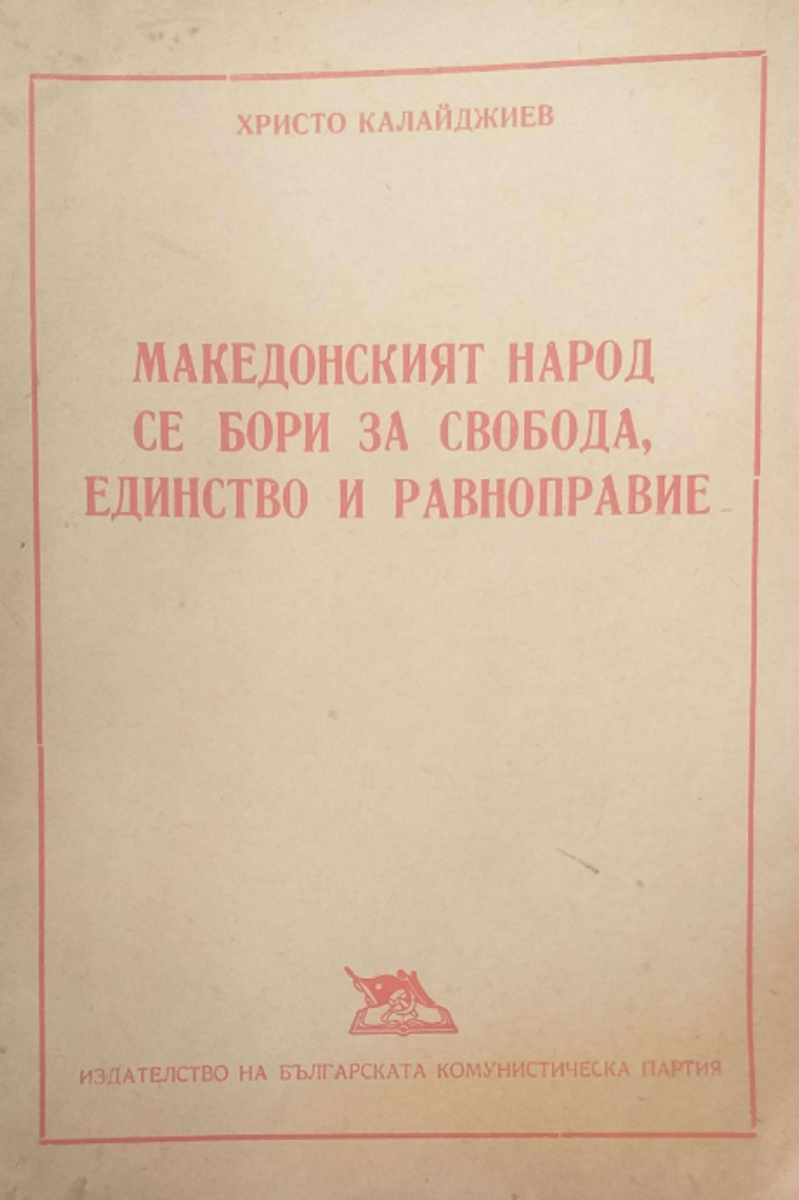
The Macedonian People Struggle for Freedom, Unity, and Equality
by Hristo Kalaidjiev, Publishing House of the Bulgarian Communist Party
More by Mircho Yurukov

More by Publishing House of the Bulgarian Communist Party

More by Hristo Kalaidjiev

Access Book
Description
The Macedonian People Struggle for Freedom, Unity, and Equality by Hristo Kalaydzhiev, published in Sofia in 1950 as a report delivered before the Conference of the Macedonian Cultural-Educational Societies in Bulgaria, addresses the political and ideological situation of Macedonia in the aftermath of the Stalin–Tito split. The text presents the Macedonian struggle within the broader framework of socialist internationalism and emphasizes solidarity with the Soviet Union and the so-called people’s democracies. It criticizes Yugoslav leadership under Tito, portraying it as deviating from socialist principles and obstructing the just resolution of the Macedonian question.
A central element of the report is the defense of a distinct Macedonian national identity, particularly in relation to Pirin Macedonia and the Macedonian communities in Bulgaria and Greece. The author frames the Macedonian liberation struggle as part of the wider anti-fascist and anti-imperialist movement, while simultaneously condemning what is described as Yugoslav revisionism and external imperialist influence. The document situates the Macedonian cause within the ideological realignments of the early Cold War period and presents unity and equality as foundational political goals.
The work belongs to the tradition of Bulgarian nationalist historiography concerning Macedonian history, shaped by the political realignments following 1948. As an official report issued under the auspices of the Bulgarian Communist Party, it reflects the institutional discourse of socialist Bulgaria at a moment of ideological confrontation with Yugoslavia. The publication serves as a primary source for examining how the Macedonian question was framed within post-war communist politics and how national identity narratives were integrated into broader geopolitical debates.
About the Authors
Author
Hristo Kalaidjiev(1886 - 1964)
Institution
The Publishing House of the Bulgarian Communist Party was the official publishing institution of the Bulgarian Communist Party (BCP) during the socialist period of Bulgaria (1946–1989). It functioned as the main channel for the publication and distribution of party literature, ideological works, Marxist-Leninist classics, political pamphlets, and propaganda materials intended to reinforce the party’s policies and worldview.
The publishing house issued books, brochures, periodicals, and theoretical journals, often focusing on communist theory, the history of the Bulgarian and international workers’ movement, and the achievements of socialism in Bulgaria. It also translated and published works of Karl Marx, Friedrich Engels, Vladimir Lenin, and other prominent figures of international communism.
Beyond political texts, the institution contributed to the dissemination of social, cultural, and educational works aligned with the principles of socialist realism and the ideological guidelines of the party. After the collapse of the communist regime in 1989, the publishing house lost its central role and gradually ceased to exist as a state-run ideological institution.