1952
Bulgarian
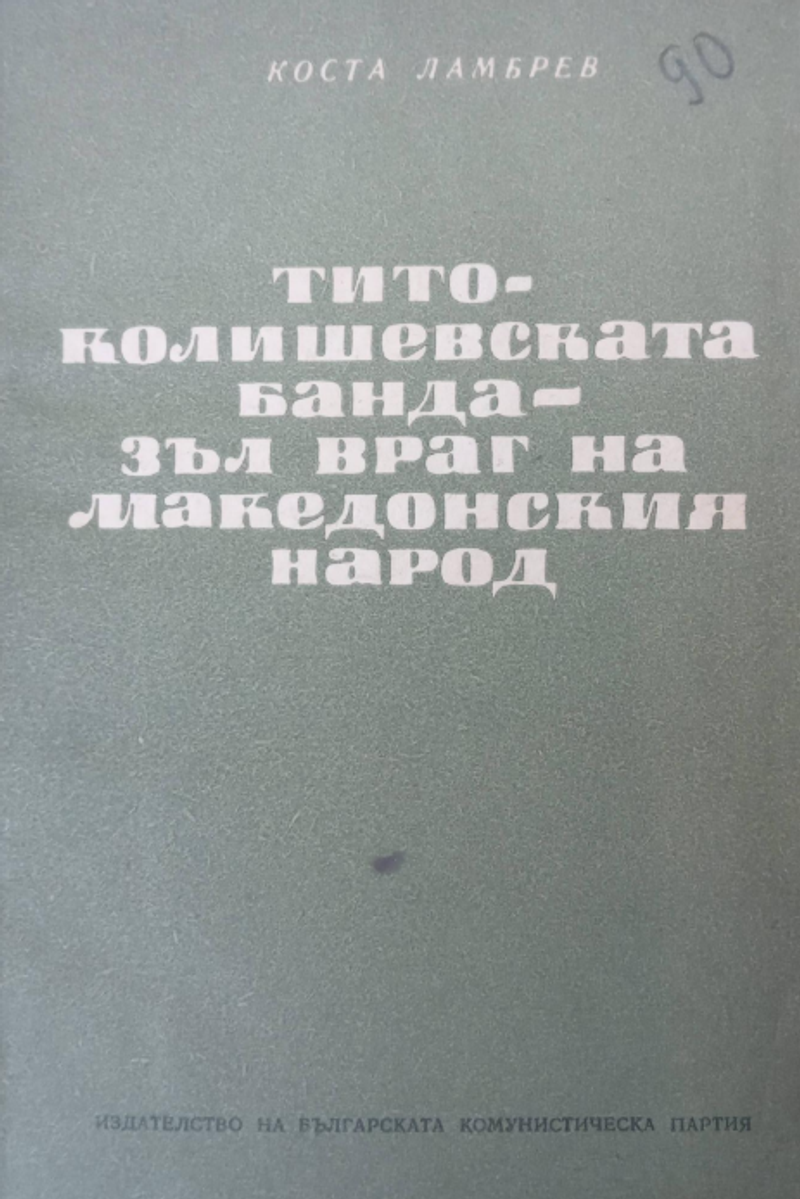
The Tito-Kolishevski Gang, Evil Enemy of the Macedonian People
by Publishing House of the Bulgarian Communist Party, Kosta Lambrev
More by Mircho Yurukov

More by Hristo Kalaidjiev

More by Kosta Lambrev

Access Book
Description
This political pamphlet, published in 1952, portrays Josip Broz Tito and Lazar Koliševski as treacherous enemies of the Macedonian people. Written during a period of heightened tension between socialist Bulgaria and Yugoslavia, it denounces the so-called “Tito–Kolishevski band” as a tool of Western imperialism, accusing them of betraying the ideals of socialism for nationalist and separatist agendas. The book positions Tito and his circle as not only hostile to Bulgaria but also as false liberators of Macedonia.
The narrative emphasizes the suffering of Macedonians under Yugoslav rule, highlighting repressions, forced assimilation, and the silencing of Bulgarian identity in Vardar Macedonia. According to the text, Tito and Koliševski orchestrated policies of terror, prisons, and executions against those who resisted their authority. The propaganda underscores that while they pretended to champion Macedonian independence, their real goal was to divide the Balkan peoples and weaken the unity of socialism.
Finally, the pamphlet calls for solidarity between Bulgaria and the “true” Macedonian people, urging resistance against Titoism and denouncing it as a betrayal of Marxism-Leninism. It insists that only through unity with Bulgaria could Macedonians secure freedom and justice. The work ends with strong ideological rhetoric, presenting Tito and Koliševski as embodiments of treason and warning the people not to be deceived by their false promises of independence and progress.
About the Authors
Institution
The Publishing House of the Bulgarian Communist Party was the official publishing institution of the Bulgarian Communist Party (BCP) during the socialist period of Bulgaria (1946–1989). It functioned as the main channel for the publication and distribution of party literature, ideological works, Marxist-Leninist classics, political pamphlets, and propaganda materials intended to reinforce the party’s policies and worldview.
The publishing house issued books, brochures, periodicals, and theoretical journals, often focusing on communist theory, the history of the Bulgarian and international workers’ movement, and the achievements of socialism in Bulgaria. It also translated and published works of Karl Marx, Friedrich Engels, Vladimir Lenin, and other prominent figures of international communism.
Beyond political texts, the institution contributed to the dissemination of social, cultural, and educational works aligned with the principles of socialist realism and the ideological guidelines of the party. After the collapse of the communist regime in 1989, the publishing house lost its central role and gradually ceased to exist as a state-run ideological institution.
Author
Kosta Lambrev(1911 - 2000)