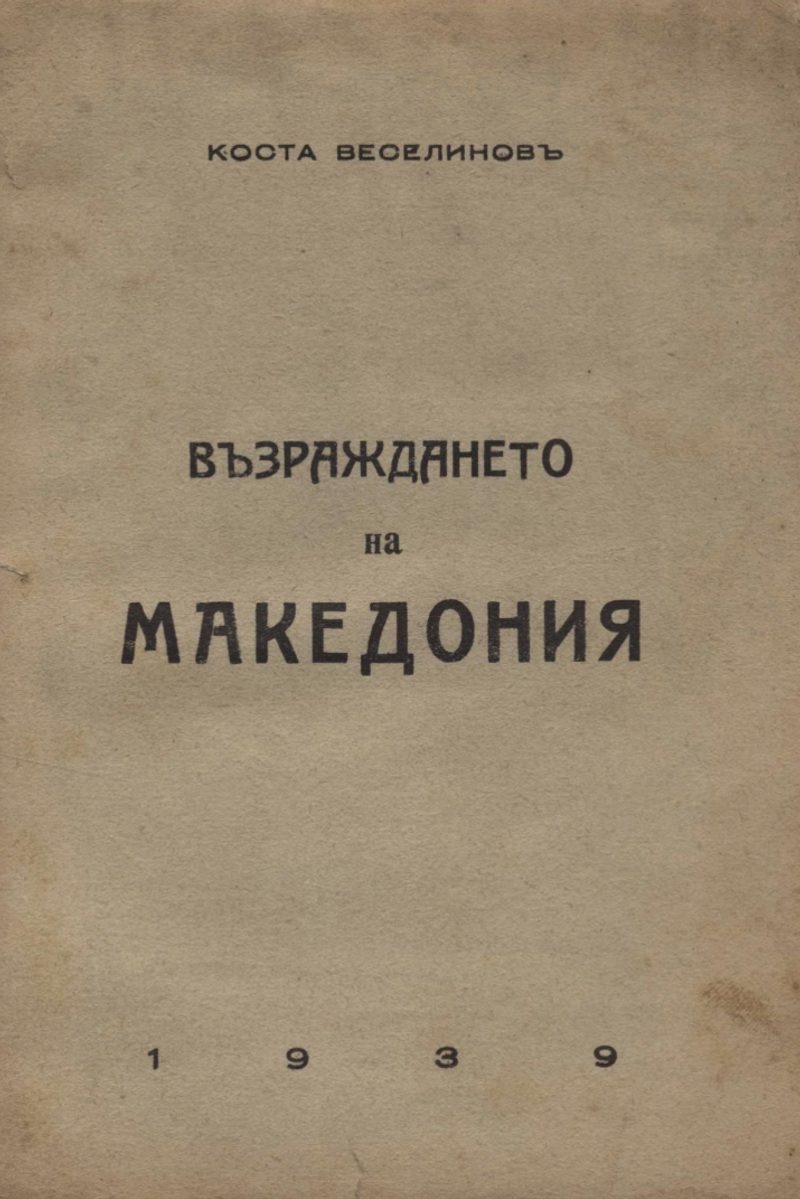
1939
Bulgarian
The Revival of Macedonia
More by Kosta Veselinov

Access Book
Description
The Revival of Macedonia by Kosta Veselinov, published in Sofia in 1939, examines the nineteenth-century awakening in Macedonia through an analysis of social, economic, and cultural transformation under Ottoman rule. The work opens with a discussion of the region’s demographic structure, trade networks, and urban development, arguing that economic change and the growth of a literate stratum played a decisive role in shaping public life. Veselinov presents the revival as a gradual process grounded in education, church organization, and emerging political awareness.
A substantial portion of the booklet focuses on educational institutions, clergy, and revolutionary activists in cities such as Thessaloniki, Bitola, and Skopje. The author treats the church struggle, the spread of schooling, and early revolutionary initiatives as interconnected stages in a broader process of national formation. While he situates many of these developments within the historical interaction between Macedonia and Bulgaria, the narrative consistently centers Macedonia as a distinct historical space with its own internal social evolution.
The publication reflects the intellectual climate of the late interwar period and illustrates how nineteenth-century developments in Macedonia were interpreted within contemporary debates about national identity and historical continuity. Written in 1939, it combines historical overview with political sensitivity to questions of culture, education, and collective memory. As a concise historical survey, the booklet serves as a source for studying how modernization, educational networks, and revolutionary organization were integrated into narratives of national awakening on the eve of the Second World War.
About the Author
Author
Kosta Veselinov(1908 - 1942)