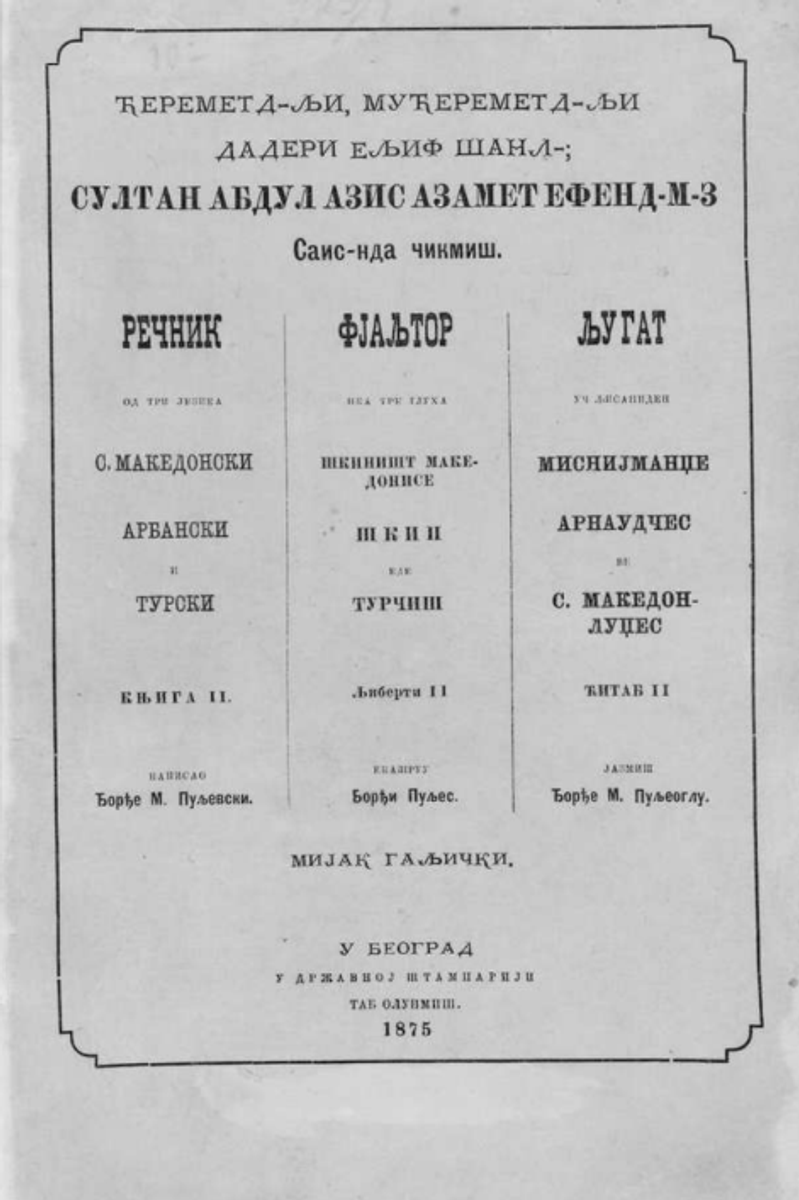
1875
Macedonian
Dictionary of Three languages


Access Book
Note
This book has been sourced from Wikimedia Commons. The work is in the public domain and may be freely used. This allows for unrestricted academic, educational, and public use.
Description
The book A Dictionary of Three languages presents the pioneering lexicographic work of Georgi Pulevski, one of the earliest advocates of a distinct Macedonian national and linguistic identity.
His Dictionary of Three languages, published in the late 19th century, is a multilingual dictionary containing Macedonian, Albanian, and Turkish entries, reflecting the cultural and linguistic diversity of the region.
More than just a dictionary, the work is considered a manifesto of national consciousness, as Pulevski openly affirmed the existence of the Macedonian language and people at a time when their identity was often denied. The book highlights Pulevski’s role as a patriot, writer, and lexicographer, whose efforts laid an early foundation for the recognition of the Macedonian nation and its language.
In his Dictionary, Pulevski includes not only lexical material but also reflections on identity and nationhood. The quotation you provided captures his view that a nation is formed by:
- common origin
- shared language
- mutual social life and friendship
- common customs, songs, and traditions
Based on this definition, he explicitly declared that:
“What do we call a nation? – People who are of the same origin and who speak the same words and who live and make friends of each other, who have the same customs and songs and festivities are what we call a nation, and the place where that people lives is called the people's fatherland. Thus the Macedonians also are a nation and their land is Macedonia.”
About the Author
Author
Georgi Pulevski(1817 - 1893)
Gjorgija Pulevski or Georgi Pulevski was a self-taught stonemason from Galichnik and a migrant worker, one of the first komitadjis and revolutionaries, a voyvoda, poet, textbook author, folklorist, ethnographer, lexicographer, grammarian, historian, and cultural-national ideologue. He was one of the most prominent and greatest Macedonian intellectuals of his time.
Born in the village of Galichnik, Georgi continued his life’s path from that of a migrant stonemason in Romania through various wars of liberation and uprisings throughout the entire second half of the 19th century. He began the struggle for the freedom of his people by participating in the liberation movements of other Balkan nations. Believing that in doing so he was also fighting for his own homeland, Pulevski first joined the liberation actions as a volunteer, during the events of 1862–1863, when, as a sergeant in a pontoon unit, he fought against the Turkish garrison in Belgrade. Later, after the outbreak of the Serbian–Turkish War (1876), he again joined as a volunteer on the side of the Serbian army.
Already in the following year, the Russo–Turkish War began, and Pulevski once more, with his unit, was in the ranks of the vanguard of the Russian army during the liberation of Bulgaria. In 1878, Pulevski actively participated as a voyvoda in the Kresna Uprising, placing himself directly in the service of the struggle for the freedom of the Macedonian people.
After the failure of the Macedonian (Kresna) Uprising, Pulevski moved to Sofia, where in 1879 he published separately the first patriotic-political poem, "Samovila Makedonska" (“The Macedonian Fairy”), in which he mentions Philip of Macedon and Alexander of Macedon as ancestors of today’s Macedonians, who ruled the entire world 300 years before Christ. The poem reflects the ideology of the Macedonian participants in the Macedonian (Kresna) Uprising.
As part of Pulevski’s activity among the Macedonian émigré community in Sofia, he was one of the founding members of the Slavo-Macedonian Literary Society in 1888. It is of particular importance as the first Macedonian literary association of any kind, and it stands as further proof of his patriotic cultural activity and his national-political orientation.