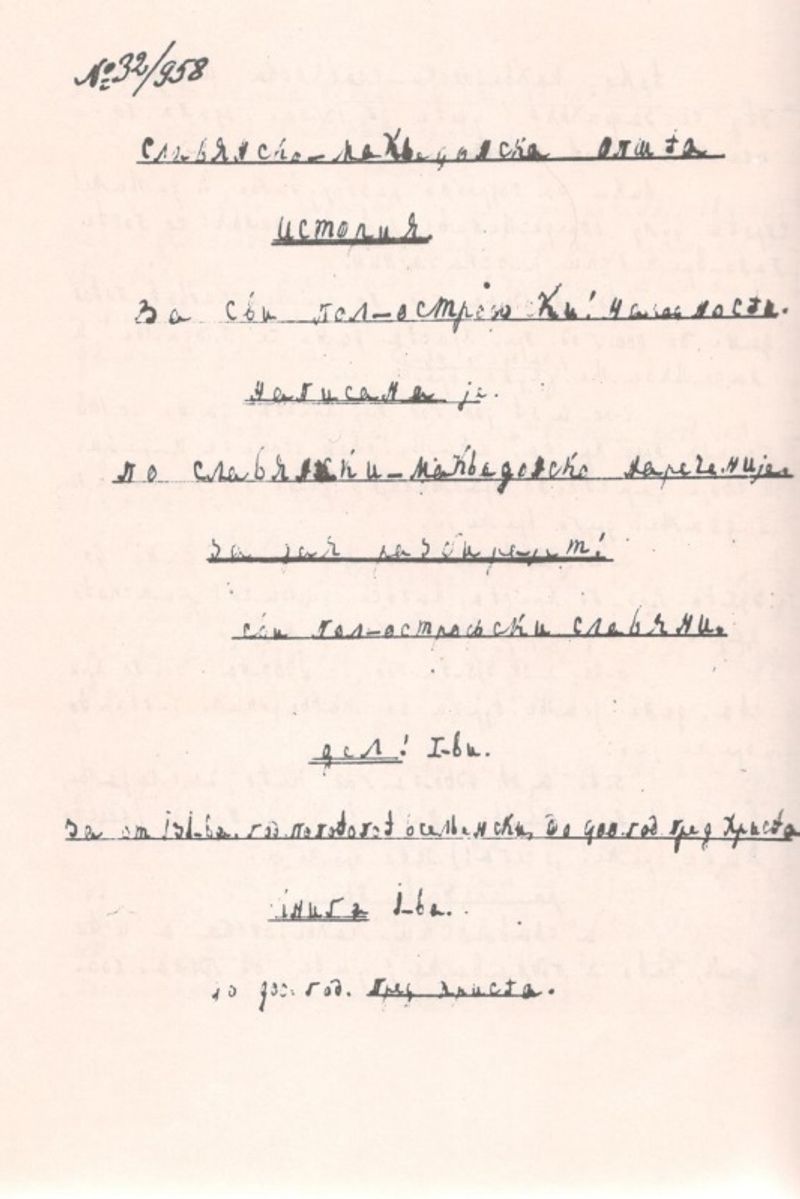
1892
Macedonian
Slavic-Macedonian General History


Access Book
Note
This book has been sourced from Wikimedia Commons. The work is in the public domain and may be freely used. This allows for unrestricted academic, educational, and public use.
Description
Slavic-Macedonian General History (Славјанско-маќедонска општа историја) by Gjorgjija Pulevski, written in 1892, is a 1688-page foundational work in Macedonian historiography.
Compiled over thirty years in Belgrade and Sofia, it aims to present a Macedonian perspective against foreign narratives. It spans from 131 years after the biblical flood to 1892, divided into five periods: Macedonian settlement from 131 to 900 BC, the kingdom era from 900 to 148 BC, Roman rule from 148 BC to 395 AD, the pre-Ottoman era from 395 to 1360, and Ottoman rule from 1360 to the late nineteenth century. The book covers Balkan and Slavic history, Macedonian customs, language, and ethnographic groups such as Brsjaci and Mijaci, citing around fifty authors.
Partially published in 1973 and 1974 and fully in 2003 by MANU and the Trifun Kostovski Foundation, it includes a section on Alexander the Great, issued as the Macedonian Alexandriad in 2005. Intended as an educational tool, the work remains central to Macedonian national identity.
About the Author
Author
Georgi Pulevski(1817 - 1893)
Gjorgija Pulevski or Georgi Pulevski was a self-taught stonemason from Galichnik and a migrant worker, one of the first komitadjis and revolutionaries, a voyvoda, poet, textbook author, folklorist, ethnographer, lexicographer, grammarian, historian, and cultural-national ideologue. He was one of the most prominent and greatest Macedonian intellectuals of his time.
Born in the village of Galichnik, Georgi continued his life’s path from that of a migrant stonemason in Romania through various wars of liberation and uprisings throughout the entire second half of the 19th century. He began the struggle for the freedom of his people by participating in the liberation movements of other Balkan nations. Believing that in doing so he was also fighting for his own homeland, Pulevski first joined the liberation actions as a volunteer, during the events of 1862–1863, when, as a sergeant in a pontoon unit, he fought against the Turkish garrison in Belgrade. Later, after the outbreak of the Serbian–Turkish War (1876), he again joined as a volunteer on the side of the Serbian army.
Already in the following year, the Russo–Turkish War began, and Pulevski once more, with his unit, was in the ranks of the vanguard of the Russian army during the liberation of Bulgaria. In 1878, Pulevski actively participated as a voyvoda in the Kresna Uprising, placing himself directly in the service of the struggle for the freedom of the Macedonian people.
After the failure of the Macedonian (Kresna) Uprising, Pulevski moved to Sofia, where in 1879 he published separately the first patriotic-political poem, "Samovila Makedonska" (“The Macedonian Fairy”), in which he mentions Philip of Macedon and Alexander of Macedon as ancestors of today’s Macedonians, who ruled the entire world 300 years before Christ. The poem reflects the ideology of the Macedonian participants in the Macedonian (Kresna) Uprising.
As part of Pulevski’s activity among the Macedonian émigré community in Sofia, he was one of the founding members of the Slavo-Macedonian Literary Society in 1888. It is of particular importance as the first Macedonian literary association of any kind, and it stands as further proof of his patriotic cultural activity and his national-political orientation.