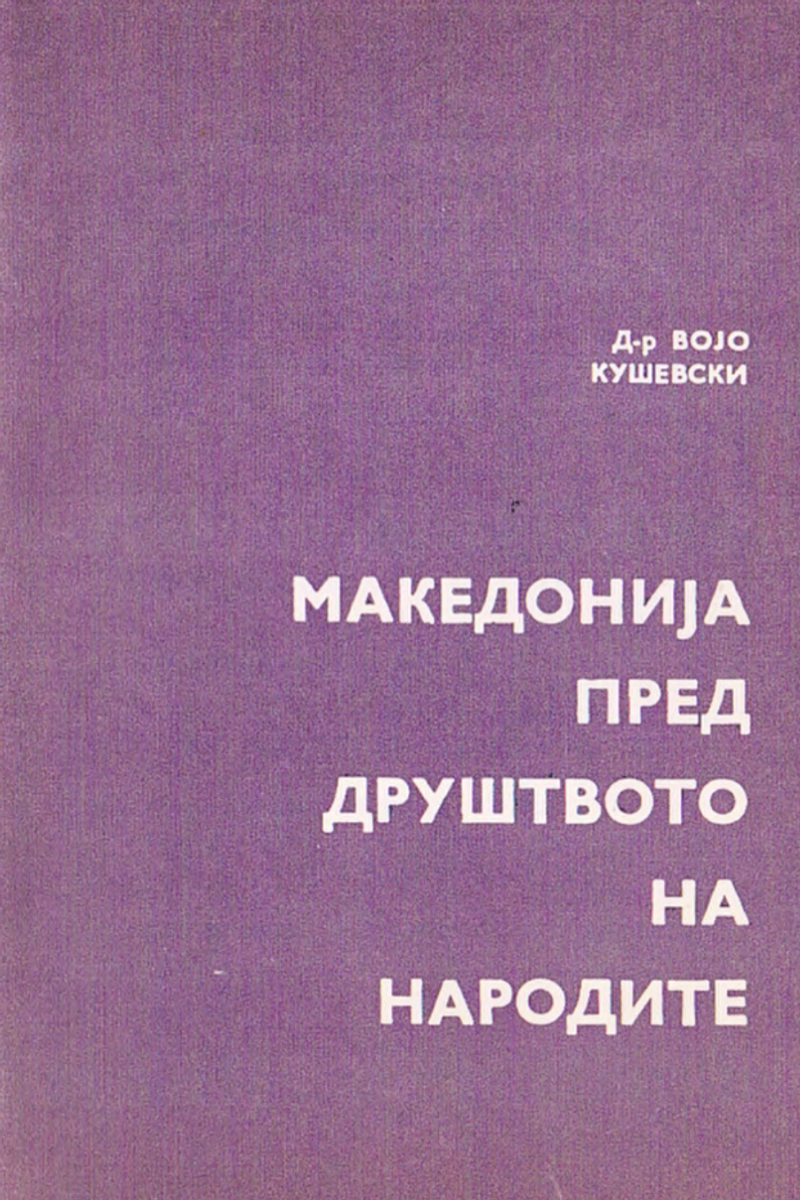
1968
Macedonian
Macedonia at the League of Nations
More by Dimče Najdevski

More by Slavko Dimevski

More by Hristo Andonovski


Access Book
Description
Macedonia at the League of Nations (1920–1921) by Vojo Kušeški examines the attempts to present the Macedonian question on the international stage in the immediate post-war period. The study opens with an analysis of the Versailles minority system and its limitations, arguing that although minority protections were formally introduced, they failed to address the specific position of the Macedonian population after the partition of the country among Balkan states. The author highlights the contradiction between the proclaimed principle of self-determination and the political realities that marginalized Macedonian national aspirations.
A substantial part of the work focuses on the activities of Macedonian organizations and émigré groups that sought recognition through petitions, memoranda, and diplomatic initiatives directed at the League of Nations. The book reconstructs appeals by Macedonian students and activists in Geneva, their meetings with League officials, and their demands for political autonomy, cultural rights, and revision of post-war treaties. Kušeški emphasizes that these efforts aimed to frame the Macedonian issue not as a minority problem but as a question of national rights and statehood.
The publication integrates documentary evidence with political interpretation to reconstruct how the Macedonian question was articulated in international forums between 1920 and 1921. Drawing on petitions, diplomatic correspondence, and contemporary commentary, the study offers insight into early attempts to internationalize the Macedonian cause and the responses of the League of Nations. As a historical analysis, the work serves as a source for understanding the interaction between Macedonian political activism and the emerging system of international minority protection after the First World War.
About the Authors
Author
Voislav Kuševski(1921 - 1999)
Institution
Radio Television Skopje(1944)