1968
Macedonian
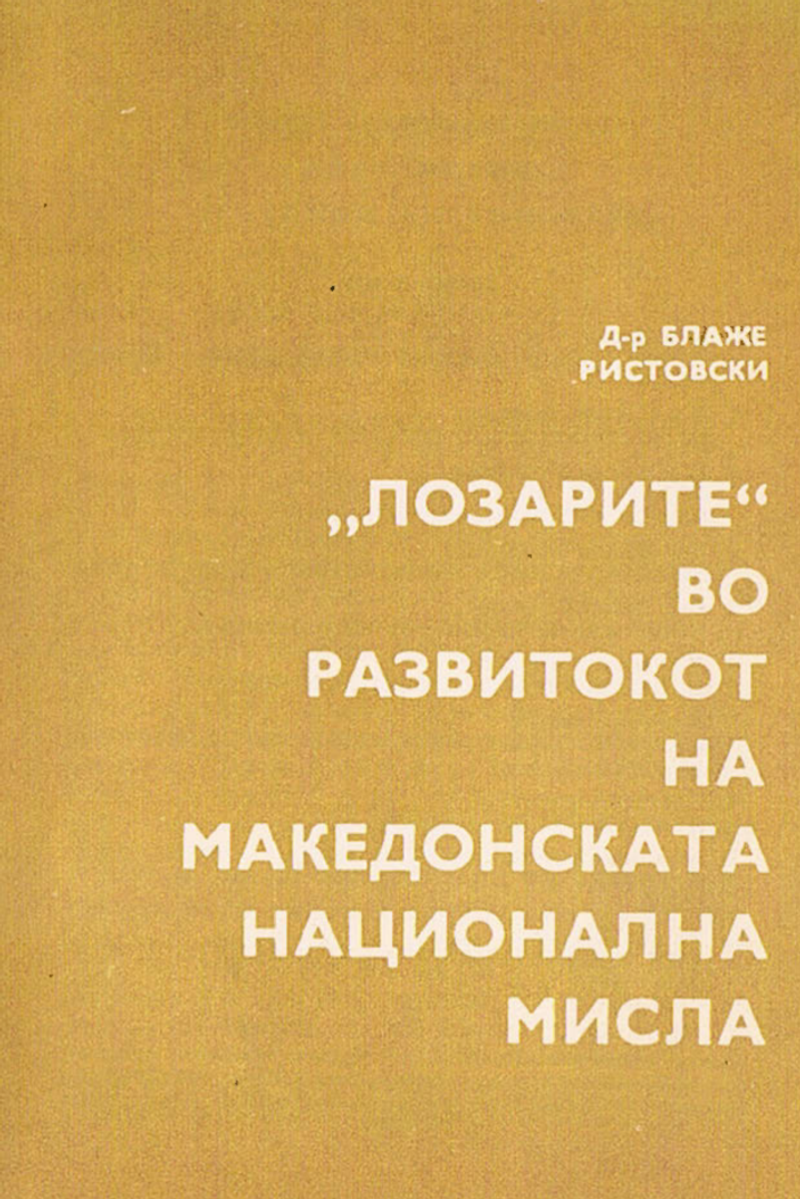
The Lozari in the Development of Macedonian National Thought
More by Voislav Kuševski

More by Dimče Najdevski

More by Slavko Dimevski

More by Hristo Andonovski

More by Radio Television Skopje


Access Book
Description
The Lozari in the Development of Macedonian National Thought examines the emergence of the young Macedonian intellectual circle in Sofia at the end of the nineteenth century and its role as a turning point in the formation of modern Macedonian national consciousness. The study opens with an overview of earlier educational and church struggles, arguing that the activities of Macedonian students and emigrants gradually crystallized into a self-aware intellectual movement. Ristovski presents the circle around the journal “Loza” as an expression of a broader cultural awakening rooted in language, education, and collective memory.
A central part of the book analyzes the formation of the Young Macedonian Literary Society and the ideological program reflected in the publication of Loza. The movement is portrayed as combining literary activity with political and cultural objectives, including the affirmation of a distinct Macedonian identity, the development of a national literary language, and resistance to external assimilation pressures. The author highlights figures such as Dame Gruev, Krste Misirkov, Petar Pop-Arsov, and other intellectuals who participated in discussions on national self-definition, education reform, and revolutionary organization. The Lozari are presented as a generation that linked cultural revival with the emerging liberation movement.
The study reconstructs the Lozari phenomenon through press analysis, memoir references, and historiographical interpretation, situating it within broader debates on national awakening in the Balkans. Written as a synthesis of intellectual and political history, the publication emphasizes the transitional character of the movement between cultural awakening and organized revolutionary activity. As a historical study, the book serves as a source for understanding the ideological foundations of the Macedonian national revival and the intellectual context that preceded the Ilinden generation.
About the Institution
Institution
Radio Television Skopje(1944)