1968
Macedonian
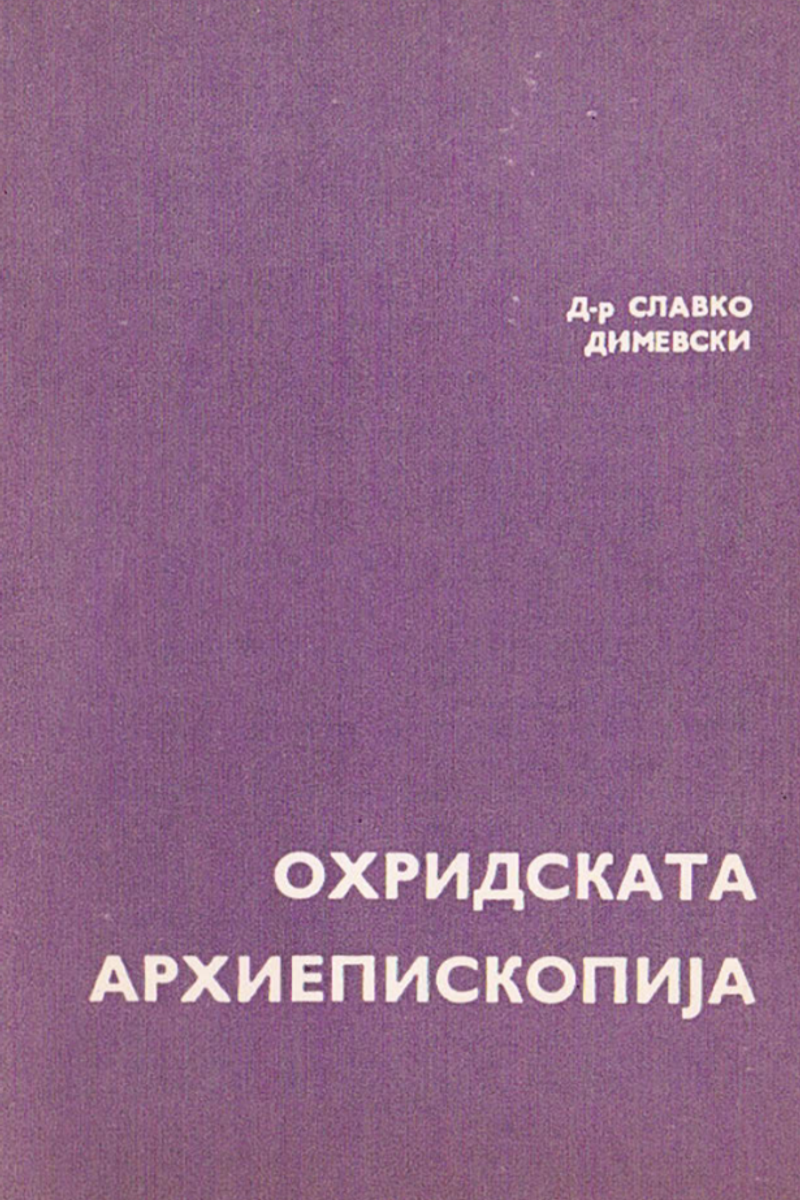
The Ohrid Archbishopric
More by Voislav Kuševski

More by Dimče Najdevski

More by Hristo Andonovski


Access Book
Description
The Ohrid Archbishopric by Slavko Dimevski is a historical study tracing the development of one of the most important ecclesiastical institutions in Macedonia from Late Antiquity to the twentieth century. The work begins with an overview of the spread of Christianity in Macedonia and the establishment of early church structures, linking the region to the legacy of Justiniana Prima and the missionary activity of Saints Cyril and Methodius. Dimevski emphasizes the role of Slavic literacy and the work of Clement and Naum as foundational for the emergence of a distinct ecclesiastical tradition centered in Ohrid.
A major part of the study examines the transformation of the Archbishopric during the medieval period, including its elevation under Tsar Samuel and its continuation after the Byzantine conquest. The institution is presented as a spiritual, cultural, and administrative center that preserved Slavic liturgical practice and fostered literary production. The narrative follows the Archbishopric through Byzantine, Serbian, and Ottoman rule, highlighting both its autonomy and the pressures it faced, culminating in its abolition in 1767. The book also explores nineteenth-century revival attempts and the struggle to restore ecclesiastical independence.
The final chapters analyze the twentieth-century movement for renewal, culminating in the re-establishment of the Archbishopric within the framework of the Macedonian Orthodox Church. The study integrates historical sources with historiographical reflection to reconstruct the institutional continuity of the Ohrid tradition across centuries of political change. As a historical synthesis, the publication serves as a source for understanding the interplay between church organization, cultural identity, and national development in Macedonia.
About the Authors
Author
Slavko Dimevski(1920 - 1994)
Institution
Radio Television Skopje(1944)