1968
Macedonian
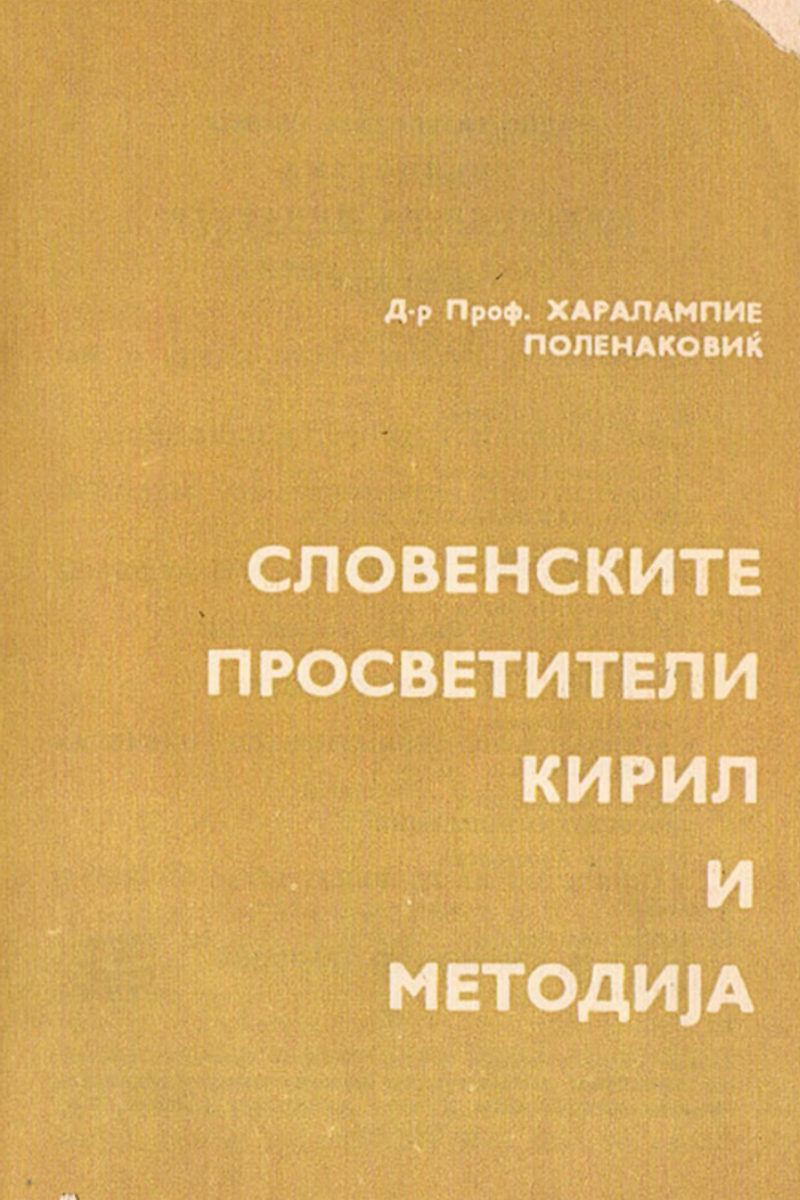
The Slavic Enlighteners Cyril and Methodius
More by Voislav Kuševski

More by Dimče Najdevski

More by Slavko Dimevski

More by Hristo Andonovski


Access Book
Description
The Slavic Enlighteners Cyril and Methodius by Haralampie Polenaković presents a historical and cultural synthesis of the life and mission of the Thessaloniki brothers, emphasizing their decisive role in shaping Slavic literacy and Christian culture. The opening part traces their background, education, and early activity within the Byzantine world, presenting their intellectual formation and the political circumstances that led to their missionary engagement.
A central section examines the creation of the Slavic alphabet, translation of liturgical texts, and the Moravian mission, highlighting how the use of the Slavic vernacular enabled broader religious participation and cultural development among Slavic populations. The study also explores the intellectual legacy of their disciples and the spread of their work through literary schools, underlining the long-term cultural influence of their mission.
The publication situates the activity of Cyril and Methodius within the broader process of medieval Slavic cultural formation and Christianization. As a historical study, the work provides insight into the development of Slavic literacy, the interaction between Byzantine and Slavic traditions, and the enduring symbolic role of the Thessaloniki brothers in the cultural history of Southeastern Europe.
About the Authors
Author
Haralampie Polenaković(1909 - 1984)
Haralampie Polenaković was one of the founding figures in the study of the history of Macedonian literature.
He served as head of the Department of the History of the Literatures of the Peoples of the Socialist Federal Republic of Yugoslavia (SFRY) and as editor-in-chief of the Encyclopedia of Yugoslavia. After the liberation, he was among the first eight professors at the Faculty of Philosophy at the University of Skopje, later serving as vice dean and dean of the Faculty.
He was also one of the founders of the Society for the Macedonian Language and Literature and editor-in-chief of the journal Literaturen zbor, as well as a founding member of the Macedonian Academy of Sciences and Arts (MANU), where he served two terms as vice president (1967–1975). Polenaković authored a large number of scholarly works in the fields of Macedonian art and folk literature, as well as studies on the literatures of other Slavic peoples.
His main academic interests included Macedonian literature, Yugoslav folklore, Balkan studies, and linguistics. Through his contributions in these areas, he took part in publications issued by all Yugoslav academies, as well as numerous international institutions, and published widely in academic and literary journals both in the country and abroad. His scholarly output includes more than 1,000 bibliographic entries.
He was decorated with the Order of Labour with the Red Banner and the Order of Merit for the People with the Gold Star. He received the City of Skopje’s “13 November” Award (1966), the “11 October” Award for Lifetime Achievement (1974), and many other prizes, commendations, and plaques.
Institution
Radio Television Skopje(1944)